Building soil organic matter in Machakos:A dryland restoration guide
Machakos County's alfisol soils were once highly productive under the traditional land management systems that built the famous Machakos terraces. Decades of continuous cropping, land fragmentation, and removal of organic matter have reduced soil organic carbon to below 1 percent across large areas — well below the 2 percent minimum needed for adequate water retention and nutrient cycling. The good news is that organic matter can be rebuilt, and in Machakos the tools — pigeon peas, zai pits, tied ridges, and on-farm composting — are inexpensive and proven.
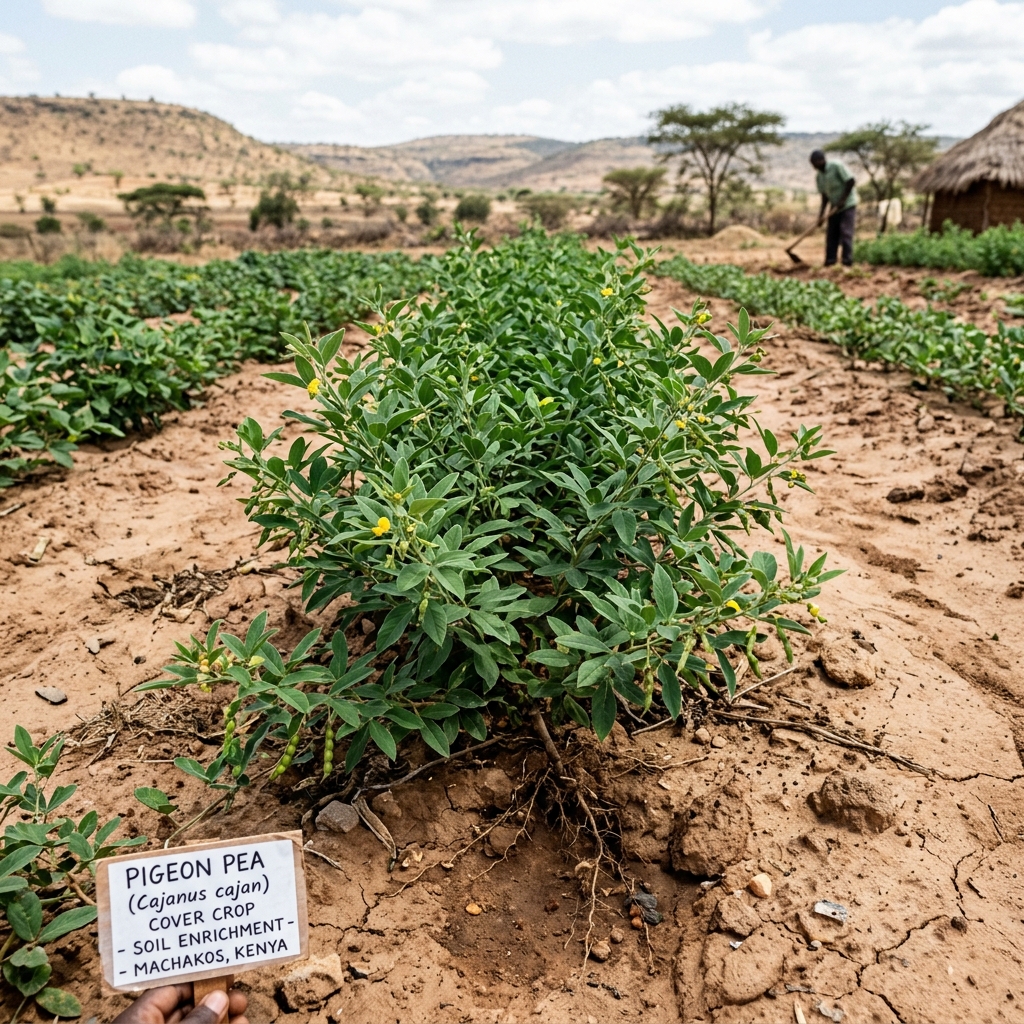
Machakos soil degradation — understanding the problem
ShambaIQ's precision soil mapping of Machakos County reveals that organic carbon across much of the county averages 0.6 to 1.2 percent — well below the 2 percent threshold that soil scientists use as the minimum for a functionally productive agricultural soil. At these levels the consequences are compounding and interconnected.
Low water-holding capacity
Organic matter acts like a sponge — each 1 percent increase in organic carbon increases the soil's water-holding capacity by approximately 20 litres per square metre. At 0.8 percent organic carbon, Machakos soils hold roughly 40 percent less water per rainfall event than they would at 2 percent. In a county where annual rainfall averages 500 to 700 mm, losing 40 percent of each rainfall event to runoff and rapid drainage is the difference between a viable crop and crop failure.
Structural collapse and crusting
Organic matter binds soil particles into stable aggregates. Below 1 percent, Machakos alfisol soils lose aggregation and the surface seals under rainfall impact, forming a crust that reduces infiltration by 60 to 80 percent. Water runs off rather than entering the soil. The crust also physically restricts seedling emergence, particularly for small-seeded crops like sorghum and green grams.
Reduced nitrogen cycling
Soil microbes that mineralise nitrogen from organic matter need organic carbon as their energy source. At 0.8 percent organic carbon, microbial biomass is low and nitrogen cycling is slow — meaning applied fertilizer must compensate for the natural nitrogen supply that a healthy soil would provide. This creates a dependency on purchased inputs that breaks down in drought years when farmers cannot afford fertilizer.
Hardpan development
Machakos alfisol soils develop a cemented hardpan layer at 20 to 35 cm depth when continuously tilled at the same depth under low organic matter conditions. This hardpan blocks root penetration, restricts water drainage into deeper soil layers, and forces crops into a very shallow root zone that exhausts available moisture within days of the last rainfall. Breaking hardpan requires deep subsoiling or persistent deep-rooted cover crops like pigeon peas.
Machakos soil organic carbon data
| Parameter | Machakos average | Target for good farming | Gap | Primary fix |
|---|---|---|---|---|
| Organic Carbon (%) | 0.6 – 1.2% | > 2.0% | Critical | Cover crops + compost |
| Soil pH | 5.8 – 6.8 | 6.0 – 7.0 | Adequate | Monitor — lime if below 5.8 |
| Total Nitrogen (g/kg) | 0.6 – 1.0 | > 1.2 g/kg | Low | Legume rotation + compost |
| Phosphorus (mg/kg) | 6 – 16 | > 15 mg/kg | Deficient | DAP at planting |
| Potassium (mg/kg) | 120 – 250 | > 100 mg/kg | Adequate | No K supplement needed |
| Water retention (mm/100mm soil) | 8 – 12 mm | > 18 mm | Low | Organic matter restoration |
Source: ShambaIQ precision soil mapping, Machakos County average. Get your farm-specific organic carbon reading here.
Cover crops — why pigeon peas are Machakos's best tool
A single cover crop species does more for Machakos soil health than any combination of purchased inputs. Pigeon peas fix nitrogen, break hardpan, add organic matter, provide grain income, and tolerate the exact rainfall conditions that Machakos experiences.
| Cover crop | Drought tolerance | N fixation (kg/acre) | Hardpan breaking | Income potential | Best use |
|---|---|---|---|---|---|
| Pigeon pea | High (> 500 mm) | 40 – 80 kg | Excellent (deep taproot) | High — grain market | Primary cover crop — interrow between maize |
| Cowpea | High (> 400 mm) | 30 – 60 kg | Moderate | Good — grain and leaf vegetable | Short rains when season too short for pigeon pea |
| Green gram | Moderate (> 500 mm) | 20 – 40 kg | Low | High per kg — niche market | Sole crop in reliable rainfall years |
| Mucuna (velvet bean) | Moderate | 80 – 120 kg | Good | Low — not edible | Fallow improvement only — not for intercropping |
Water harvesting — zai pits and tied ridges
In semi-arid Machakos, the primary limiting factor is not total rainfall but rainfall capture. Two low-cost technologies capture 40 to 70 percent more of each rainfall event for crop use.
Zai pits
Labour only — KES 2,000–4,000/acre
Dig planting basins 20–30 cm diameter, 15 cm deep, spaced 60 cm within rows and 80 cm between rows. Fill each pit with a double handful of compost before planting. When rain falls, water concentrates in pits rather than running off. Organic matter in the pit feeds soil microbes that dramatically improve local soil structure within 2 to 3 seasons.
Tied ridges
Ox plough time — KES 1,500–2,500/acre
Plough ridges across the slope contour. Every 3 to 4 metres along the ridge, leave a small cross-tie that creates a connected series of water storage basins across the entire field. Water is intercepted before it can flow downhill and held in the field for gradual infiltration.
Drought-tolerant crop selection for Machakos
| Crop | Min rainfall (mm) | Season length | Market | Reliability |
|---|---|---|---|---|
| Sorghum | 400 | 90 – 120 days | NCPB + local brewers | Very high |
| Cowpeas | 400 | 60 – 75 days | Local + Nairobi | High |
| Pigeon peas | 500 | 150 – 200 days | Local + export | High |
| Cassava | 450 | 9 – 18 months | Local | Very high |
| Green grams | 500 | 60 – 70 days | Premium local | Moderate |
| Maize (DUMA 43) | 600 | 90 – 100 days | NCPB + local | Moderate |
Step-by-step: building soil organic matter in Machakos
- 1
Baseline your soil organic carbon with ShambaIQ
Use ShambaIQ at shambaiq.com/app?county=machakos to get your farm's current organic carbon reading. Machakos soils commonly show 0.6 to 1.2 percent organic carbon — below the 2 percent minimum for good soil structure and water retention. Knowing your starting point lets you track improvement season by season.
- 2
Dig zai pits for water harvesting before the rains
Dig zai pits (small planting basins 20 cm diameter, 15 cm deep) during the dry season before rain arrives. Space at 60 cm within rows and 80 cm between rows. Fill each pit with a double handful of compost or aged manure. When rain comes, water concentrates in the pits rather than running off — extending effective moisture availability by 2 to 3 weeks beyond normal rainfall.
- 3
Plant drought-tolerant crops with pigeon pea interrows
Plant maize or sorghum in the zai pits at the first reliable rainfall. Between every two maize rows, plant a row of pigeon peas as an intercrop. Pigeon peas do not compete significantly with maize during the first 6 weeks while maize is establishing, then continue growing after maize harvest to fix nitrogen and add leaf litter organic matter through the dry season.
- 4
Never burn crop residues — mulch instead
After maize harvest, cut stalks at ground level and lay them flat between the crop rows as mulch. A 5 to 8 cm layer of maize stover mulch reduces soil surface evaporation by 30 to 50 percent, moderates soil temperature by 3 to 5 degrees Celsius, and decomposes over 6 to 12 months to add organic matter. Burning destroys months of organic matter accumulation and releases carbon that took the entire season to fix.
- 5
Build a compost system using on-farm materials
Establish a simple compost heap using crop residues, animal manure, kitchen waste, and green biomass from pigeon pea prunings. Layer 30 cm of dry material with 10 cm of green material and a thin layer of soil. Water to maintain moisture. Compost is ready in 2 to 3 months. Apply at 2 to 3 tonnes per acre per season — the equivalent of 40 to 60 wheelbarrow loads for a one-acre plot.
- 6
Build tied ridges for season-long moisture conservation
At the start of each season, form ridges across the slope contour using a jembe or ox plough. Every 3 to 4 metres along the ridge, leave a small cross-ridge (tie) that creates a series of connected water storage basins. Tied ridges reduce runoff by 40 to 70 percent on Machakos' gently sloping alfisol soils — capturing rainfall that would otherwise leave the field and be unavailable to crops.
Free Precision Tool
Protect Against Drought: Plan your dryland cover crops with ShambaIQ Machakos Arid Advisor.
ShambaIQ shows your Machakos farm's current organic carbon level and gives you a season-by-season restoration plan using cover crops and composting. Free. No sign-up required.
Open Machakos Arid Advisor