Kenya county soil rankings 2026:Which counties have the best farming soil?
Not all Kenyan soils are equal — and the gap between the best and worst counties is not a matter of luck. It is geology, rainfall, land management history, and the accumulated effect of farming decisions made over decades. ShambaIQ has mapped soil quality across all 47 counties using precision soil prediction models calibrated against ground-truth data, scoring each county on pH, nitrogen, phosphorus, potassium, and organic carbon. Here is what the data shows.
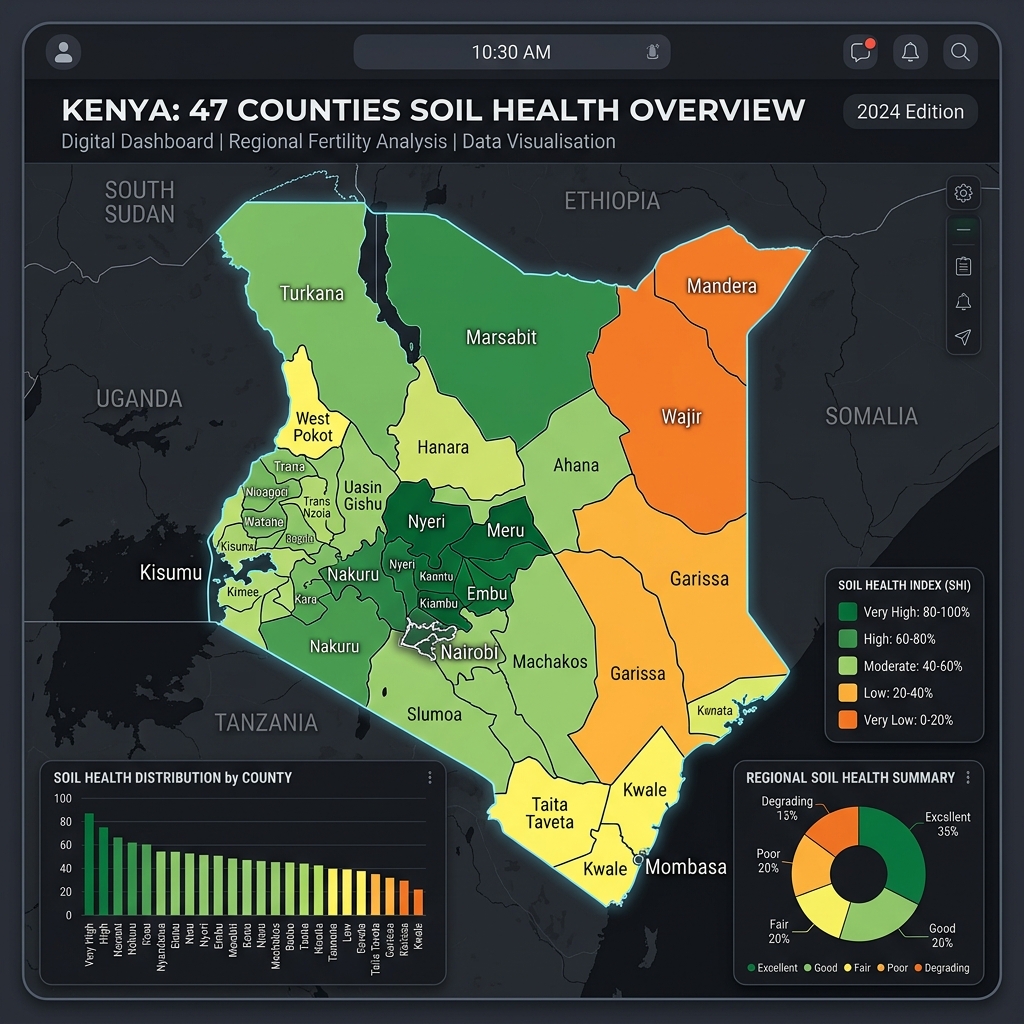
How we rank Kenya's county soils
The County Soil Quality Index (CSQI) aggregates five soil parameters, each scored against agronomic optima for general crop production and weighted by impact on yield.
Soil pH
30%
Controls nutrient availability and aluminium toxicity
Organic Carbon
25%
Water retention, microbial activity, nutrient cycling
Nitrogen
20%
Primary yield-limiting nutrient across most crops
Phosphorus
15%
Root development and energy transfer
Potassium
10%
Disease resistance and water regulation
Top 10 counties by soil quality index — 2026
| Rank | County | Zone | pH range | N | P | Oc | Best crop | Csqi |
|---|---|---|---|---|---|---|---|---|
| #1 | Kiambu | Central Highlands | 5.2–6.0 | High | Moderate | High | Cabbage, Tomato, Tea | 82 |
| #2 | Murang'a | Central Highlands | 5.0–6.2 | High | Moderate | High | Maize, Coffee, Avocado | 80 |
| #3 | Uasin Gishu | Rift Valley Highlands | 5.5–6.5 | High | Moderate | High | Wheat, Maize, Potato | 79 |
| #4 | Nyeri | Central Highlands | 4.8–5.8 | High | Low–Moderate | High | Coffee, Tea, Potato | 77 |
| #5 | Nakuru | Rift Valley | 5.8–6.8 | Moderate–High | Moderate | Moderate–High | Maize, Wheat, Vegetables | 76 |
| #6 | Nandi | Western Highlands | 5.2–6.0 | Moderate–High | Moderate | High | Tea, Maize, Dairy Fodder | 74 |
| #7 | Kirinyaga | Central Highlands | 5.5–6.5 | Moderate–High | Moderate | Moderate–High | Rice, Tomato, Maize | 73 |
| #8 | Meru | Central Highlands | 4.5–5.5 | High | Low | High | Miraa, Tea, Maize (with lime) | 71 |
| #9 | Trans Nzoia | Rift Valley Highlands | 5.5–6.5 | High | Moderate | High | Maize, Potato, Sunflower | 71 |
| #10 | Kakamega | Western Highlands | 4.8–5.5 | Moderate–High | Low | Moderate–High | Maize, Beans, Sugarcane | 69 |
CSQI = County Soil Quality Index (0–100). Source: ShambaIQ precision soil mapping 2026. Check your farm's specific score here.
Best counties by crop type
The overall CSQI is useful but the crop-specific rankings tell a more practical story. A county that ranks 15th overall may rank 1st for a specific crop if its soil chemistry matches that crop's requirements precisely.
Maize
Uasin Gishu leadsTop: Uasin Gishu, Trans Nzoia, Nakuru, Bungoma, Nandi
Deep fertile soils, pH 5.8–6.8, adequate phosphorus, reliable long rains above 900mm
Wheat
Uasin Gishu leadsTop: Uasin Gishu, Nakuru, Laikipia, Trans Nzoia
Cool highland temperatures, low humidity during grain fill, pH 6.0–7.0, low disease pressure
Tea
Kiambu leadsTop: Kiambu, Murang'a, Nyeri, Kericho, Nandi, Bomet
Acidic soils pH 4.5–5.5, high rainfall above 1,400mm, cool temperatures, free-draining slopes
Tomato
Kirinyaga leadsTop: Kirinyaga, Kiambu, Kajiado (irrigated), Taita Taveta
Well-drained soils, warm days, calcium availability, proximity to Nairobi processing market
Onion
Kajiado leadsTop: Kajiado, Machakos, Narok, Taita Taveta
Dry conditions for bulb curing, irrigation access, low humidity that reduces fungal disease
Potato
Nyandarua leadsTop: Nyandarua, Nyeri, Meru, Trans Nzoia, Uasin Gishu
Cool temperatures, well-drained loam soils, altitude above 1,800m, low late blight pressure
Beans
Kakamega leadsTop: Kakamega, Bungoma, Kisii, Nyamira, Murang'a
Two reliable seasons, moderate temperatures, soils that support Rhizobium activity after liming
Rice
Kirinyaga (Mwea) leadsTop: Kirinyaga (Mwea), Kisumu, Homabay, Siaya, Tana River
Flat terrain, irrigation infrastructure, vertisol clay soils that retain water for paddy conditions
ASAL counties — managing low-ranked soils
The 23 ASAL counties — covering 80 percent of Kenya's land area — rank lower on the CSQI not because farming is impossible but because the crops and management strategies required are different. Matching crop to soil and climate is the core precision principle.
Kajiado
Onions and tomatoes under drip irrigation. Alkaline soils are an advantage for onion post-harvest curing. Proximity to Nairobi is a market advantage that compensates for the input cost of irrigation.
Machakos / Makueni / Kitui
Sorghum, pigeon peas, cowpeas, cassava, and green grams as primary crops. Zai pits and tied ridges for water harvesting. Organic matter restoration as the 3-season investment before intensifying with vegetables.
Laikipia
Dryland wheat and barley on the higher plateaux. Ranch-integrated farming combining livestock and fodder crops. Export horticulture under irrigation where groundwater access exists.
Tana River / Kilifi
Coastal cashew nuts, coconuts, and cassava on sandy soils. Irrigation-based horticulture along the Tana River. Mangrove-adjacent aquaculture integration with smallholder farming.
How to improve your county's soil rank
County averages mask huge farm-level variation. A farm in Kakamega (ranked 10th overall) can outperform a farm in Kiambu (ranked 1st) if the Kakamega farmer has limed to pH 6.0, applied Rhizobium, and built organic matter while the Kiambu farmer has done nothing. The ranking is a starting point — management determines the outcome.
| Intervention | Csqi impact | Time to result | Cost/acre | Priority |
|---|---|---|---|---|
| Lime acidic soils to pH 6.0–6.5 | +15 to +25 points | 1–2 seasons | KES 7,000–28,000 | Critical for pH below 5.5 |
| Apply compost 3–5 t/acre/season | +5 to +10 points | 2–4 seasons | KES 3,000–8,000 | High — all counties |
| Incorporate crop residues (no burning) | +3 to +7 points | 2–3 seasons | Labour only | High — especially ASAL |
| Legume cover crop rotation | +5 to +12 points | 1–3 seasons | KES 1,500–4,000 | High for low-N soils |
| Correct phosphorus application | +3 to +5 points | Immediate | KES 2,000–5,000 | Medium — check first |
Free precision tool
Check your county's exact soil score — get a personalised fertilizer plan for your farm.
See your county's soil score and your farm's specific pH, nitrogen, phosphorus, potassium, and organic carbon values. Free, no sign-up required.
Check my county soil score