DAP vs CAN vs NPK fertilizer:Which should you use in Kenya?
Walk into any Kenyan agrovet and you face the same three products: DAP, CAN, and NPK 17:17:17. Most farmers buy what their neighbour uses without understanding what each product actually does in their specific soil. The wrong choice wastes money — applying DAP to alkaline Kajiado soil raises pH further and damages onion roots; applying CAN to beans suppresses nitrogen fixation that would have supplied nitrogen for free. This guide explains what each product does and when to use which.
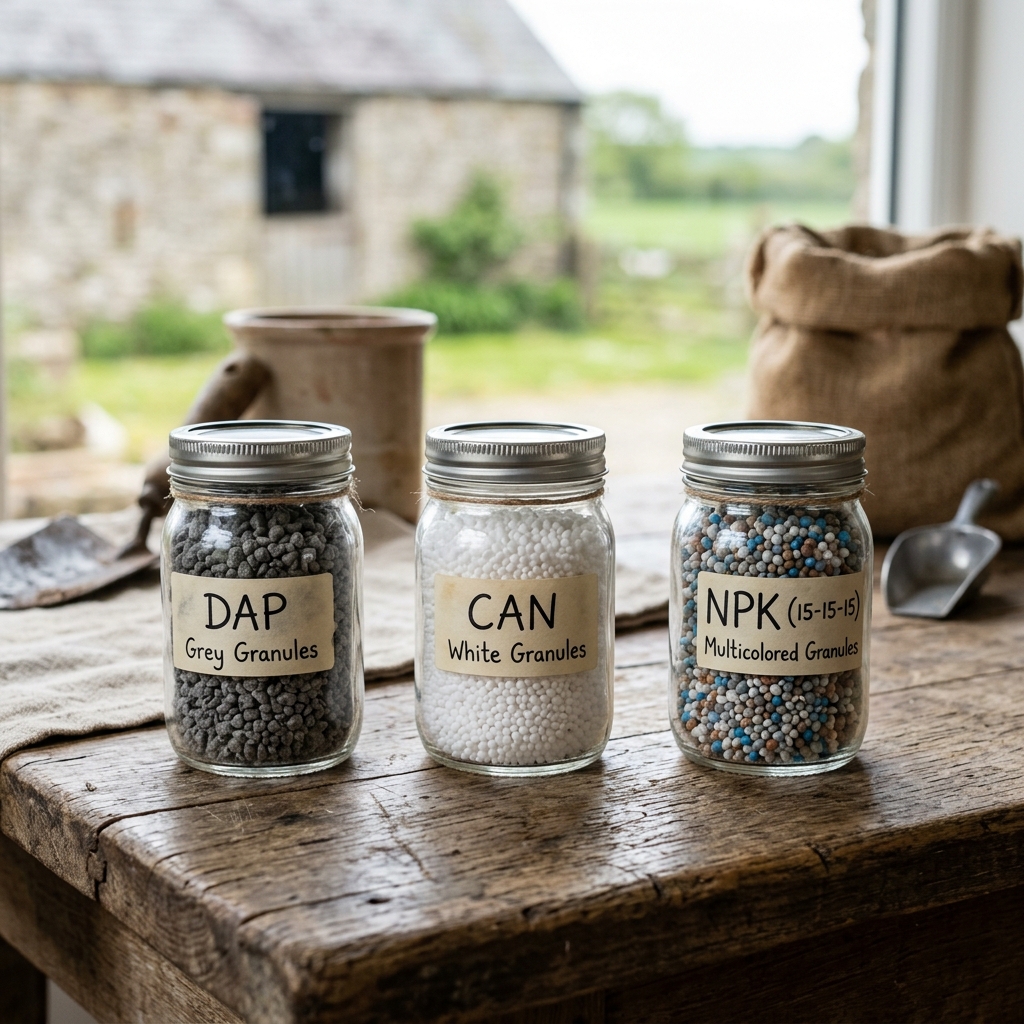
Side-by-side comparison: DAP vs CAN vs NPK 17:17:17
| Property | DAP (18:46:0) | CAN (26:0:0) | NPK (17:17:17) |
|---|---|---|---|
| Nitrogen (%) | 18% | 26% | 17% |
| Phosphorus (%) | 46% | 0% | 17% |
| Potassium (%) | 0% | 0% | 17% |
| Calcium | None | 8% Ca | None |
| Price per 50 kg bag (KES) | 4,000–4,500 | 3,200–3,800 | 4,200–4,800 |
| Application timing | At planting (basal) | Top-dress at knee height | At planting (basal) |
| Best for | Maize, wheat, potato at planting | All crops needing N top-dress | Vegetables, alkaline soils, balanced needs |
| NOT suitable for | Alkaline soils (pH > 7.5) | Beans (suppresses N-fixation) | High-P needs (use DAP instead) |
| Acidifying effect | Moderate | Moderate | Low |
DAP — when to use and when to avoid
DAP (Di-Ammonium Phosphate, 18:46:0) is Kenya's most widely used basal fertilizer. Its high phosphorus content (46%) makes it the most cost-effective source of phosphorus for root development at planting. Apply in the furrow 5 cm below and 5 cm beside the seed — never in direct contact.
Use DAP when:
✓Soil pH is 5.5 To 7.0 (Acidic to neutral)
✓Soil phosphorus is below 15 mg/kg
✓Planting maize, wheat, potato, or vegetables
✓You need the most P per shilling spent
Avoid DAP when:
✗Soil pH is above 7.5 (Kajiado, narok, Baringo)
✗Growing beans or other legumes
✗Soil phosphorus is already above 20 mg/kg
✗You need potassium — DAP has zero K
CAN — the top-dress nitrogen source
CAN (Calcium Ammonium Nitrate, 26% N) contains both ammonium and nitrate nitrogen. Nitrate is immediately plant-available while ammonium is absorbed more slowly — providing both immediate and sustained nitrogen supply. The 8% calcium content makes CAN the correct top-dress choice on calcium-deficient soils.
CAN vs Urea: Why CAN is more reliable for smallholders
Urea (46% N) is cheaper per unit of nitrogen but loses 20 to 30 percent to volatilisation when applied to the soil surface in hot conditions — common in most Kenyan farming zones. CAN volatilises less because its nitrate component does not need soil conversion before uptake. For smallholders who cannot incorporate fertilizer after application, CAN delivers more usable nitrogen per shilling despite higher bag price.
NPK 17:17:17 — the balanced option
NPK 17:17:17 supplies nitrogen, phosphorus, and potassium in equal proportions. It is the correct choice when all three macronutrients are needed simultaneously — common for vegetables in early growth and on alkaline soils where DAP is inappropriate.
The cost trade-off: NPK 17:17:17 at 50 kg per acre provides only 8.5 kg of phosphorus per acre — less than half of DAP's 23 kg. For crops with high phosphorus demand on phosphorus-deficient soils, DAP is more cost-effective. For crops needing balanced nutrition (onions, cabbages, tomatoes in establishment), NPK 17:17:17 eliminates the need for separate potassium application.
Which fertilizer for which crop
| Crop | At planting | Top-dress | Do not use | Why |
|---|---|---|---|---|
| Maize | DAP 50 kg/acre | CAN 50 kg/acre at knee height | NPK (wasteful K) | Maize needs high P at planting, high N at V6-V8 |
| Wheat | DAP 75 kg/acre | CAN 50 kg/acre at tillering | Urea (volatilises) | Wheat needs more P than maize for root mass |
| Beans | Rock phosphate 50 kg or DAP 25 kg | NONE | CAN, Urea, NPK | Beans fix own N — external N suppresses nodules |
| Onion (Kajiado) | NPK 17:17:17 50 kg | Ammonium sulfate 50 kg | DAP (raises alkaline pH) | Alkaline soils need acidifying N source |
| Cabbage | DAP 50 kg + NPK 25 kg | CAN 50 kg at 3 and 6 weeks | Urea alone (Ca deficiency) | Heavy feeder needing balanced NPK + Ca from CAN |
| Tomato | DAP 50 kg | CAN 50 kg at 2, 5, 8 weeks | Excess N at fruiting | Late N delays ripening and reduces shelf life |
Free Precision Tool
Stop guessing which fertilizer to buy — get your exact bag count and budget for your crop and county.
Get your farm-specific soil data and recommendations. Free. No sign-up required.
Open ShambaIQ