Farming in semi-arid Kenya:Precision strategies for Machakos, Makueni, and Kitui
Machakos, Makueni, and Kitui counties cover Kenya's largest contiguous dryland farming zone — over 36,000 square kilometres of alfisol soils receiving 400 to 800 mm of erratic annual rainfall. Conventional extension advice fails here because it was developed for highland conditions and assumes rainfall regularity that does not exist. Precision farming in semi-arid Kenya starts from a different premise: work with the rainfall that arrives rather than managing for the rainfall you hope for. These three counties share the same challenges — low organic carbon, phosphorus deficiency, and unpredictable moisture — but each has distinct sub-county variation that demands targeted rather than blanket recommendations.
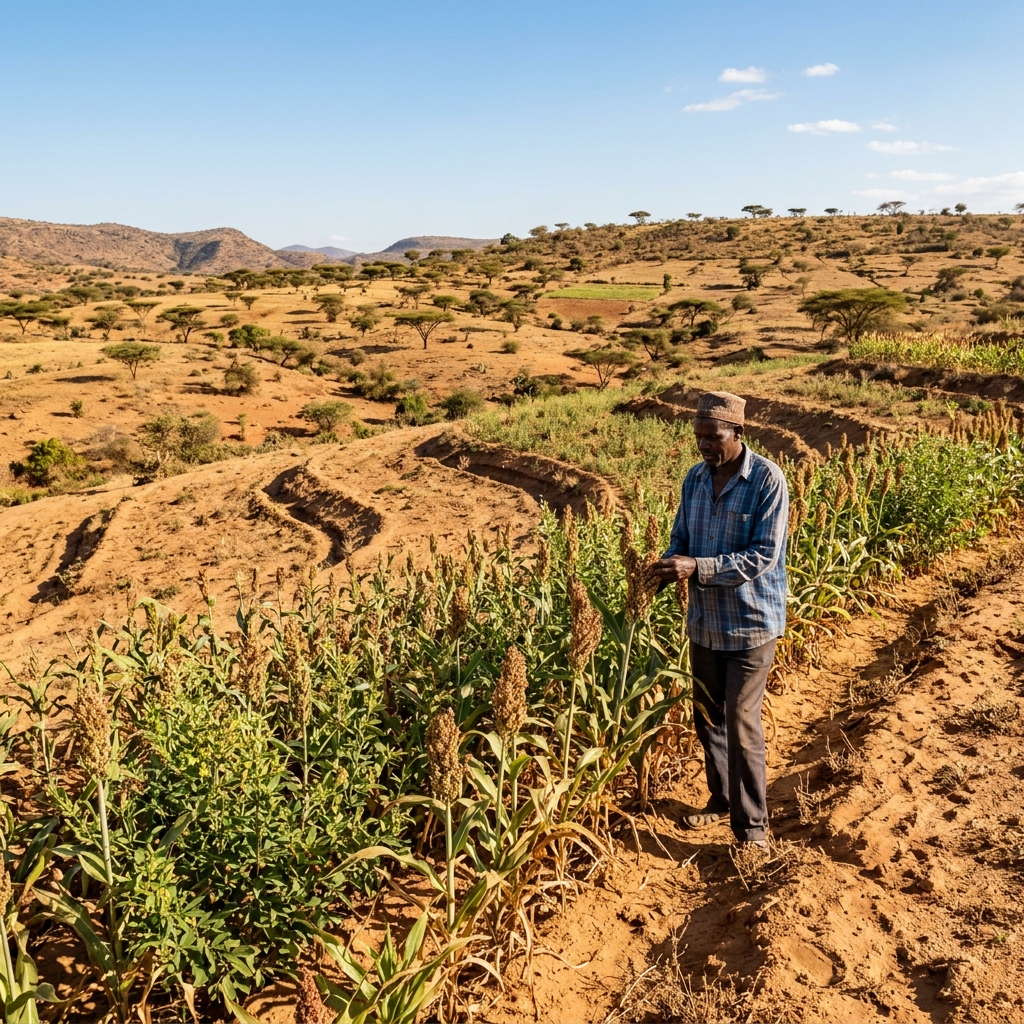
Three counties, one challenge — different solutions
Machakos, Makueni, and Kitui share the lower eastern Kenya dryland belt but differ meaningfully in altitude, rainfall, and market access. Understanding these differences determines which precision strategies apply to your specific sub-county.
Machakos County
Highest altitude of the three. Highland sub-counties (Mwala, Kangundo) viable for maize. Closest to Nairobi's premium vegetable markets.
Makueni County
Kenya's largest mango-producing county. Wote and Emali sub-counties have irrigation potential from Athi River catchment. Strong fruit processing infrastructure.
Kitui County
Largest of the three counties by area. Significant groundwater in seasonal rivers. Sand dam technology most advanced here — over 3,000 sand dams built by community groups.
Soil data comparison: Machakos vs Makueni vs Kitui
| Parameter | Machakos | Makueni | Kitui | Crop optimum |
|---|---|---|---|---|
| Soil pH | 6.0 – 6.8 | 5.8 – 6.8 | 6.2 – 7.5 | 6.0 – 6.5 |
| Organic Carbon (%) | 0.6 – 1.4 | 0.5 – 1.0 | 0.4 – 0.9 | > 2.0% |
| Total Nitrogen (g/kg) | 0.6 – 1.2 | 0.5 – 1.0 | 0.4 – 0.8 | > 1.2 g/kg |
| Phosphorus (mg/kg) | 8 – 18 | 5 – 14 | 4 – 12 | > 15 mg/kg |
| Potassium (mg/kg) | 120 – 280 | 100 – 220 | 80 – 200 | > 100 mg/kg |
| Water retention (mm/100mm) | 8 – 14 | 6 – 11 | 5 – 10 | > 18 mm |
Source: ShambaIQ precision soil mapping, county averages at 0–20 cm depth. Get your farm-specific values here.
Crop selection by rainfall zone
The single most important precision decision in semi-arid farming is matching crop to rainfall — not applying more fertilizer to the wrong crop. This table ranks crops by minimum viable rainfall and expected return.
| Crop | Min rainfall | Season length | Yield/acre | Revenue/acre | Best county zone |
|---|---|---|---|---|---|
| Sorghum | 350 mm | 90–120 days | 8–15 bags | KES 24,000–45,000 | All three — most reliable |
| Cowpeas | 400 mm | 60–75 days | 4–8 bags | KES 32,000–64,000 | All three — fastest cash |
| Pigeon peas | 450 mm | 150–200 days | 3–6 bags | KES 30,000–60,000 | Machakos, Makueni highlands |
| Green grams | 450 mm | 60–70 days | 3–5 bags | KES 36,000–60,000 | All three — premium market price |
| Cassava | 400 mm | 9–18 months | 5–12 tonnes | KES 50,000–120,000 | Kitui lowlands, Makueni |
| Mango | 500 mm | Perennial | 2–6 tonnes | KES 60,000–180,000 | Makueni — established value chain |
| Maize (DUMA 43) | 550 mm | 85–100 days | 8–16 bags | KES 28,000–56,000 | Machakos highlands only |
| Onion (irrigated) | Drip | 110–120 days | 15–20 tonnes | KES 300,000–500,000 | Kajiado border, Makueni irrigated |
Water harvesting — the technology that makes semi-arid farming viable
In semi-arid Kenya, the limiting factor is not total annual rainfall — it is rainfall capture. Without water harvesting, 30 to 60 percent of every rainfall event runs off the surface and leaves the farm before roots can absorb it.
Zai pits
Labour only — KES 2,000–4,000/acre
Small planting basins (20–30 cm diameter, 15 cm deep) filled with compost concentrate water and nutrients at the root zone. Each pit captures 3 to 5 litres per rainfall event. After 2 to 3 seasons of compost additions, the pit zone develops dramatically better soil structure than surrounding soil — creating permanent micro-zones of fertility.
Dig during dry season. Benefits from first rain.
Tied ridges
Ox plough — KES 1,500–2,500/acre
Ridges across slope contour with cross-ties every 3 to 4 metres create connected water storage basins across the entire field. Water is intercepted before it can flow downhill. Most effective on slopes of 2 to 15 percent — the gradient range covering most farmland in all three counties.
Build at season start. Rebuild annually.
Sand dams
Community — KES 200,000–500,000 per dam
Concrete weirs across seasonal rivers that trap sand during floods. The sand stores water that can be accessed via shallow wells for months after the last rain. Kitui County has over 3,000 sand dams — more than anywhere else in Africa — enabling drip irrigation, livestock watering, and domestic use in areas that would otherwise be waterless for 6 months per year.
Multi-year community investment. 20+ year lifespan.
Fertilizer strategy for semi-arid soils
Fertilizer management in semi-arid conditions requires a fundamentally different approach from highland farming. The key principle: organic matter first, phosphorus second, nitrogen only when moisture is assured.
| Input | Rate/acre | When | Why in semi-arid context |
|---|---|---|---|
| Compost / manure | 2–5 tonnes | Before planting into zai pits | Builds water retention — the primary yield constraint. Each 1% OC increase = 20 L/m² more water held |
| DAP | 25–50 kg | In planting furrow at planting | Phosphorus for root development. Lower rate than highland — half the fertilizer at half the moisture produces similar P availability |
| CAN | 25–50 kg | At knee height — ONLY if rains established | Skip entirely in dry years. N applied to moisture-stressed crops volatilises without root uptake. Wasted money. |
| Rock phosphate | 50–100 kg | Pre-plant broadcast | Slow-release P alternative to DAP. Cheaper per unit P. Better suited to single-application semi-arid systems where farmers cannot return to field for top-dress |
The compost-first principle for semi-arid soils
On Machakos, Makueni, and Kitui soils at 0.6 to 1.0 percent organic carbon, spending KES 5,000 on compost and KES 2,000 on DAP will outperform spending KES 7,000 on DAP and CAN alone. The compost improves water retention — the primary yield constraint — while DAP and CAN only supply nutrients that cannot be absorbed without adequate soil moisture. Fix the water problem first and the fertilizer works harder.
Drip irrigation for smallholders — economics and setup
Where water is available — from sand dams, boreholes, farm ponds, or seasonal rivers — drip irrigation transforms semi-arid smallholder farming economics from subsistence to commercial.
| Item | 0.25 Acre system | 0.5 Acre system | 1 Acre system |
|---|---|---|---|
| Drip tape and fittings | KES 8,000 | KES 15,000 | KES 25,000 |
| Water tank (elevated) | KES 5,000 | KES 8,000 | KES 12,000 |
| Pump (solar or manual) | KES 8,000 | KES 12,000 | KES 20,000 |
| Total infrastructure | KES 21,000 | KES 35,000 | KES 57,000 |
| Annual operating cost | KES 4,000 | KES 7,000 | KES 12,000 |
| Revenue (tomato/onion) | KES 60,000–150,000 | KES 120,000–300,000 | KES 250,000–500,000 |
| Payback period | 1 season | 1 season | 1–2 seasons |
Step-by-step: dryland farming in Machakos, Makueni, and Kitui
- 1
Check soil data for your specific sub-county
Use ShambaIQ at shambaiq.com to get your farm's exact soil pH, organic carbon, phosphorus, and nitrogen values. Machakos, Makueni, and Kitui each have significant internal variation — highland Machakos at 1,400 m altitude has different soil and rainfall than lowland Kitui at 700 m. A single county recommendation is insufficient — sub-county precision matters.
- 2
Build water harvesting structures before the rains
During the dry season before expected rains, dig zai pits (20 cm diameter, 15 cm deep, 60 cm apart) and build tied ridges across slope contours. Fill each zai pit with a double handful of compost. These structures capture 40 to 70 percent of rainfall that would otherwise run off the field surface. On a 1-acre plot, zai pits require 3 to 5 days of labour — the single highest-return investment for dryland farming.
- 3
Select crops by your rainfall zone, not by neighbour's choice
Match your crop to your specific location's average rainfall. Below 500 mm: sorghum, millet, cowpeas, and cassava only. At 500 to 700 mm: add pigeon peas, green grams, sweet potatoes, and drought-tolerant maize (DUMA 43). Above 700 mm: standard maize, beans, and vegetables become viable with water harvesting. Never plant maize in zones below 500 mm — it will fail in 3 out of 5 years.
- 4
Apply compost and low-rate DAP at planting
Apply compost at 2 to 3 tonnes per acre into zai pits or along planting furrows. Add DAP at 25 to 50 kg per acre in the planting furrow. Do not apply CAN top-dress unless rains are clearly established and consistent — nitrogen applied to drought-stressed crops volatilises from the soil surface without root uptake, wasting the input entirely.
- 5
Practise staggered planting to spread risk
Do not plant the entire farm on the same day. Plant 40 percent of the acreage at the first reliable rain, 30 percent one week later, and the remaining 30 percent two weeks later. If the season fails early, the last planting may still produce. If the season is good, all three plantings succeed. This simple risk management technique costs nothing and dramatically reduces the probability of total crop failure.
- 6
Integrate livestock and crop residues for organic matter cycling
After crop harvest, feed residues to livestock and return the manure to the cropping fields as compost. This closed nutrient loop is the only sustainable way to build organic carbon from 0.8 percent to the 2 percent target that transforms water retention, soil structure, and long-term productivity on Machakos, Makueni, and Kitui's degraded alfisol soils.
Cost comparison: rainfed vs irrigated semi-arid farming per acre
| Rainfed sorghum + cowpea | Drip-irrigated onion | |
|---|---|---|
| Seed / seedlings | KES 2,000 | KES 8,000 |
| Fertilizer (DAP + compost) | KES 5,000 | KES 12,000 |
| Water / irrigation | KES 0 | KES 15,000 |
| Drip infrastructure (amortised) | KES 0 | KES 9,000 |
| Labour | KES 4,000 | KES 8,000 |
| Pesticide / fungicide | KES 1,000 | KES 5,000 |
| Total Cost | KES 12,000 | KES 57,000 |
| Revenue | KES 56,000–109,000 | KES 300,000–500,000 |
| Net margin | KES 44,000–97,000 | KES 243,000–443,000 |
Rainfed budget assumes good season. In drought years, rainfed income drops to KES 15,000–30,000 while irrigated income is stable. Find agrovets and input prices across all three counties here.
Free precision tool
Get a drought-resilient crop plan built from your county's actual soil data.
ShambaIQ maps your specific sub-county's soil data and rainfall zone, then recommends the crops and inputs that match your conditions — not a county average. Free. No sign-up required.
Open Semi-Arid Advisor