Kakamega soil guide:Mavuno fertilizer vs DAP — which wins on Western Kenya soils?
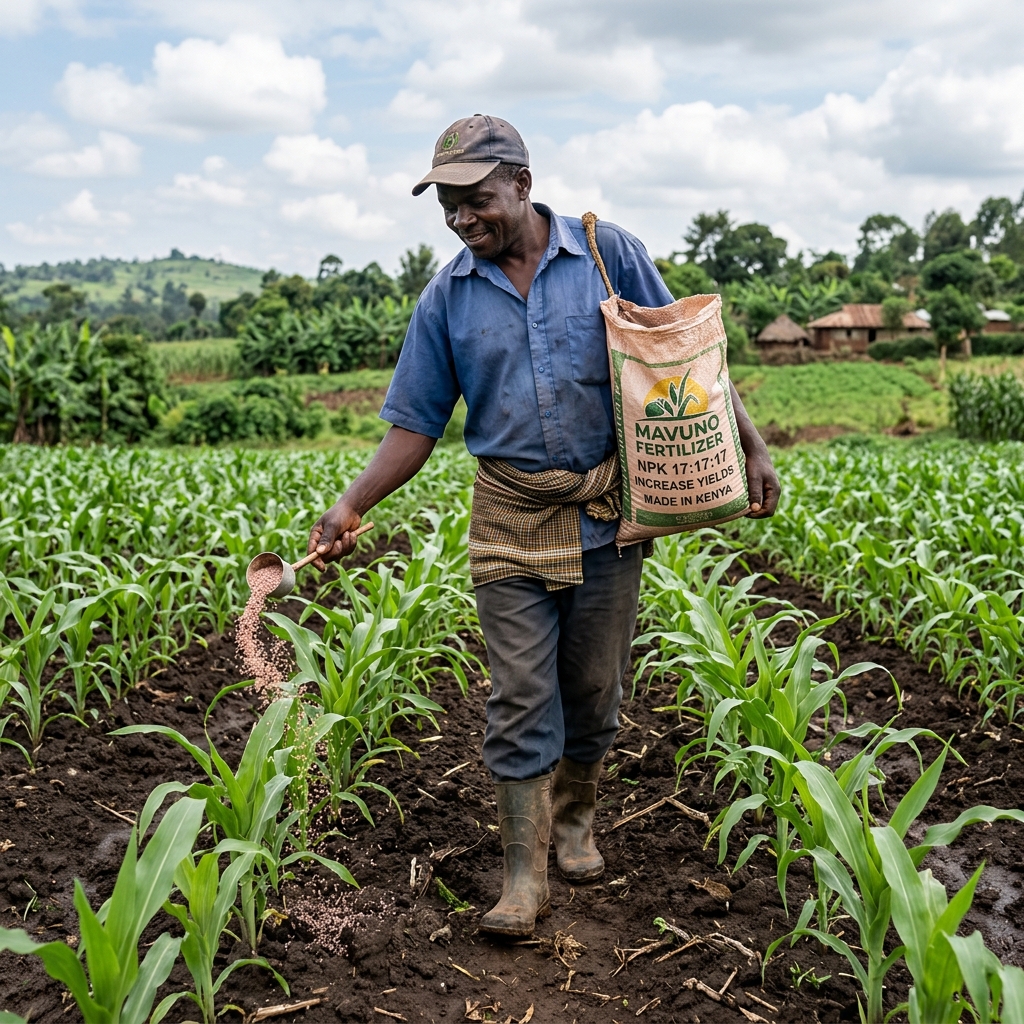
Mavuno is Kenya's most popular compound fertilizer brand — formulations developed specifically for East African soils. In Kakamega County's phosphorus-deficient, slightly acidic soils, the question of Mavuno vs DAP is one of the most common decisions smallholder farmers face. The answer depends on your specific soil nutrient profile. This guide uses ShambaIQ's precision data for Kakamega to show exactly when each product wins.
Kakamega soil profile — what the data shows
| Parameter | Kakamega average | Crop optimum | Implication for fertilizer choice |
|---|---|---|---|
| Soil pH | 4.8–5.5 | 6.0–6.5 | Lime before any fertilizer on soils below 5.5 |
| Phosphorus (mg/kg) | 6–14 | > 15 mg/kg | P-deficient — DAP's high P content is the advantage |
| Potassium (mg/kg) | 80–180 | > 80 mg/kg | Low-to-adequate — Mavuno's K content matters here |
| Nitrogen (g/kg) | 1.2–2.0 | > 1.2 g/kg | Adequate — CAN top-dress sufficient |
| Organic Carbon (%) | 1.5–2.5 | > 2.0% | Moderate — maintain with crop residues |
| Sulfur | Often deficient | Adequate | Mavuno's 4% S is an advantage on S-deficient farms |
Source: ShambaIQ precision mapping, Kakamega County. Get your farm-specific values.
Mavuno planting vs DAP — head-to-head on Kakamega soils
| Factor | DAP (18:46:0) | Mavuno planting (26:10:10:4s) | Winner for Kakamega |
|---|---|---|---|
| P per 50 kg bag | 23 kg | 5 kg | DAP — 4.6x more P |
| N per 50 kg bag | 9 kg | 13 kg | Mavuno — but N comes from CAN anyway |
| K per 50 kg bag | 0 kg | 5 kg | Mavuno — matters if K < 80 mg/kg |
| Sulfur | None | 2 kg | Mavuno — if S-deficient |
| Cost per bag | KES 4,200 | KES 4,500 | DAP — more P per shilling |
| Best scenario | P below 10 mg/kg, K adequate | P moderate, K deficient, S deficient | Depends on your soil |
The ShambaIQ verdict for most Kakamega farms
On the majority of Kakamega farms where phosphorus is the primary limiting nutrient (below 10 mg/kg), DAP provides more phosphorus per shilling and should remain the default basal fertilizer. Switch to Mavuno Planting only if ShambaIQ confirms your farm has both potassium deficiency (below 80 mg/kg) AND moderate phosphorus (above 12 mg/kg). The data decides — not the brand name.
Complete fertilizer programme for Kakamega maize
| Stage | If P < 10 mg/kg (use DAP) | If P > 12 & K < 80 (use Mavuno) |
|---|---|---|
| Pre-plant (if pH < 5.5) | Lime 1–1.5 t/acre, 3 weeks before | Same |
| At planting | DAP 50 kg in furrow | Mavuno Planting 50 kg in furrow |
| Top-dress (knee height) | CAN 50 kg/acre | Mavuno Top Dress 50 kg or CAN 50 kg |
| Total N applied | 22 kg/acre | 26–43 kg/acre |
| Total P applied | 23 kg/acre | 5 kg/acre |
| Total K applied | 0 kg/acre | 5–10 kg/acre |
Why Mavuno is wrong for Kakamega beans
Mavuno Planting contains 26% nitrogen — beans do not need it
Mavuno Planting's high nitrogen content (26%) actively suppresses Rhizobium nodule formation in beans. Beans fix 40 to 80 kg of atmospheric nitrogen per acre per season at zero cost through Rhizobium bacteria in root nodules. Applying Mavuno to beans costs more than DAP, provides less phosphorus, and reduces the free nitrogen fixation that makes beans valuable in a rotation system. For Kakamega beans, the correct basal is rock phosphate at 50 kg or DAP at 25 kg — phosphorus only, no nitrogen.
Free Precision Tool
See whether Mavuno or DAP wins for your specific crop and farm location in Western Kenya.
Get your farm-specific soil data and recommendations. Free. No sign-up required.
Open ShambaIQ