Precision bean cultivation in Kakamega:Double your harvests
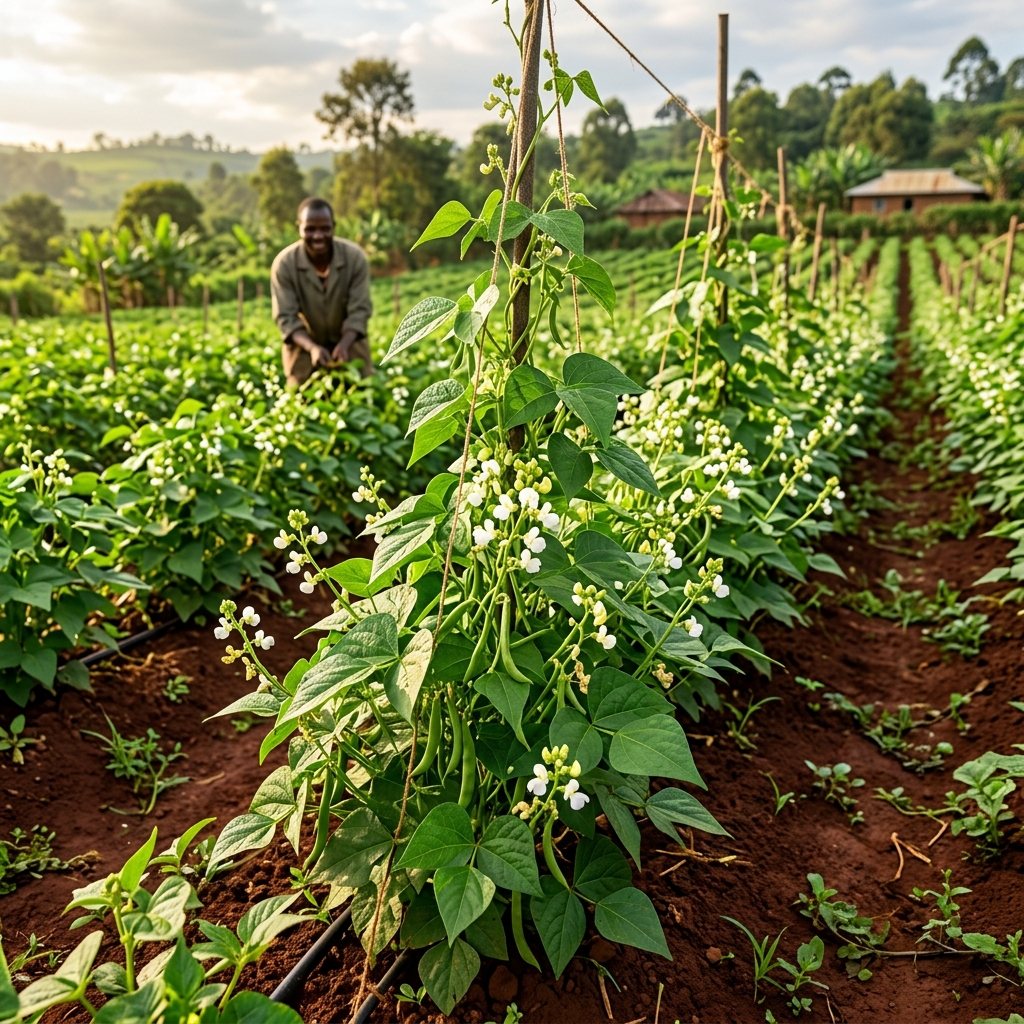
Beans are Kenya's second-most-important food crop and a critical protein source for Western Kenya households. In Kakamega County, they are also one of the most systematically under-managed crops — most farmers harvest 3 to 5 bags per acre when the same farm under precision management is capable of 10 to 14 bags. The gap is not irrigation, not rainfall, not seed price. It is three decisions made at planting: inoculating seed with Rhizobium, applying phosphorus at the correct low rate, and planting certified virus-free seed. Get all three right and Kakamega's leached acidic soils become highly productive bean land at minimal input cost.
Why Kakamega beans are an underperforming asset
Kakamega's 1,500 to 1,900 mm annual rainfall, fertile appearance of its red soils, and two reliable growing seasons create conditions that should produce consistently high bean yields. The gap between potential and actual production has three causes that are entirely within farmer control.
Kakamega's high rainfall progressively leaches calcium and raises soil aluminium concentration. The result — soil pH of 4.8 to 5.5 across most of the county — directly damages the root nodules where Rhizobium fixes nitrogen. Farmers who do not lime before planting beans are planting into conditions where the nitrogen fixation system that makes beans so valuable cannot function. Most of the fertilizer applied to compensate is also poorly available at low pH.
Bean Common Mosaic Virus (BCMV) and Bean Common Mosaic Necrotic Virus (BCMNV) are seed-borne — once introduced to a seed stock they persist in every subsequent generation saved from that harvest. Most Kakamega farmers recycle seed for 3 to 5 seasons before replacing it. By season 3, virus incidence in recycled seed lots reaches 40 to 60 percent, causing the mosaic, curling, and pod distortion that farmers accept as normal variation. A single generation of certified virus-indexed seed resets the entire disease burden.
A well-nodulated bean plant fixes 40 to 80 kg of atmospheric nitrogen per acre per season at zero input cost. When nitrogen fertilizer is applied, the plant downregulates nodule formation — it detects that nitrogen is available and reduces its investment in the nodule system. The result is that farmers who apply CAN to beans pay for nitrogen they do not need while suppressing the free nitrogen fixation that would have occurred without any input at all.
Kakamega soil data for beans
| Nutrient | Kakamega average | Bean optimum | Status | Action |
|---|---|---|---|---|
| Soil pH | 4.8 – 5.5 | 5.5 – 7.0 | Acidic — Critical | Lime to 5.8+ before planting |
| Total Nitrogen (g/kg) | 1.2 – 2.0 | Supplied by Rhizobium | Irrelevant | Do NOT apply nitrogen fertilizer |
| Phosphorus (mg/kg) | 6 – 14 | > 12 mg/kg | Deficient | Rock phosphate or low DAP at planting |
| Potassium (mg/kg) | 80 – 180 | > 80 mg/kg | Low – Adequate | Returned by crop residue incorporation |
| Organic Carbon (g/kg) | 15 – 25 | > 12 g/kg | Adequate | Maintain — beans add organic matter |
Source: ShambaIQ precision soil mapping, Kakamega County average. Get your farm-specific bean suitability score here.
Rhizobium inoculant — free nitrogen from the air
Nitrogen fixation by Rhizobium is one of the most economically significant biological processes in smallholder farming. A single application of Rhizobium inoculant costing KES 200 to 400 per acre delivers nitrogen fixation equivalent to KES 1,500 to 2,500 per acre of CAN fertilizer — and does so continuously throughout the season as the plant grows.
How Rhizobium Inoculation Works in Practice
Rhizobium bacteria in the inoculant colonise bean roots within 7 to 14 days of planting
The plant forms root nodules — small pink or red bumps visible when you gently pull a root
Inside each nodule, Rhizobium converts atmospheric nitrogen (N2) to ammonium (NH4+) that the plant can use
A well-nodulated bean plant produces 40 to 80 kg of plant-available nitrogen per acre at zero additional cost
After harvest, nodule decomposition releases residual nitrogen into the soil — benefiting the following maize crop
Why inoculant fails on unlimed Kakamega soils
Rhizobium bacteria are sensitive to soil acidity. At pH below 5.5, aluminium toxicity damages root tips before Rhizobium can colonise them, and the low pH environment inhibits bacterial survival in the soil. Farmers who apply inoculant to unlimed Kakamega soils at pH 4.8 wonder why they see no pink nodules at 6 weeks. The lime investment is the precondition — inoculant only works reliably at pH 5.5 and above.
Certified bean varieties for Western Kenya
Kenya Mavuno
Climbing bush
KEPHIS-certified. Excellent angular leaf spot resistance — the primary foliar disease in Kakamega's humid conditions. High protein content preferred by Nairobi dry bean processors.
Jesca
Bush
Shorter season than Mavuno — useful for double-cropping in both long and short rains. Good BCMV tolerance. Favoured by Kakamega commercial growers targeting the Busia and Kisumu fresh markets.
Wairimu DM1
Bush
Preferred for the Nairobi dry bean wholesale market due to consistent cream colour and uniform seed size. Moderate angular leaf spot resistance — spray preventively in Kakamega's humid conditions.
Rose Coco (Mwitemania)
Bush
Premium price at fresh pod stage — sold green to Nairobi supermarkets and urban markets. Requires harvesting at 55 to 60 days for the fresh market. Lower dry grain yield than other varieties.
Bean common mosaic virus — managing Kakamega's primary disease
BCMV is seed-borne and aphid-transmitted. Once present in a field, it cannot be cured. The entire management strategy is prevention through three simultaneous interventions.
Plant certified virus-indexed seed
The most impactful single intervention. Certified seed lots are tested for BCMV at less than 0.1 percent incidence. Buying certified seed every 2 to 3 seasons resets the virus burden regardless of farm history. Cost: approximately KES 1,200 to 1,800 per acre for certified seed versus KES 400 to 600 for recycled seed — a KES 800 to 1,200 difference that is recovered many times over in yield improvement.
Treat seed with imidacloprid to control aphid vectors
Aphids colonise bean plants from seedling emergence and transmit BCMV during feeding. Imidacloprid seed treatment at 2 g per kg of seed provides systemic aphid protection for 3 to 4 weeks — covering the most vulnerable early growth stage. Cost: approximately KES 200 per acre. Apply imidacloprid the day before planting, allow to dry, then apply Rhizobium inoculant fresh on planting morning.
Remove infected plants immediately
At the first sign of mosaic symptoms — mottled light and dark green leaf patterns, leaf puckering, or pod distortion — remove the entire plant including roots and destroy it away from the field. Infected plants serve as a virus reservoir for aphids feeding on them and moving to healthy plants. Leaving even a few infected plants doubles the spread rate within the crop.
Step-by-step: growing beans in Kakamega county
- 1
Check soil pH — beans fail below pH 5.5
Use ShambaIQ at shambaiq.com/app to confirm your soil pH. Kakamega's leached acidic soils commonly show pH 4.8 to 5.5. Below pH 5.5, aluminium toxicity damages root nodules before Rhizobium bacteria can establish — the nitrogen fixation system fails entirely. If your pH is below 5.5, apply 500 kg to 1 tonne of agricultural lime per acre at least 3 weeks before planting. Do not skip liming on strongly acidic Kakamega soils and expect Rhizobium to work — it will not.
- 2
Apply rhizobium inoculant to seed on planting day
Mix certified bean seed with Rhizobium inoculant paste immediately before planting, following package directions (typically 5 to 10 g per kg of seed). The inoculant must coat the seed surface uniformly. Keep inoculated seed in shade and plant within 4 hours — ultraviolet light kills the bacteria rapidly. Do not mix inoculant with any fungicide seed treatments — fungicides kill Rhizobium. If you use fungicide seed dressing, apply it the previous day and allow to dry, then apply Rhizobium inoculant fresh on planting morning.
- 3
Apply rock phosphate or low-rate DAP in the furrow
Apply rock phosphate at 50 kg per acre or DAP at 25 to 30 kg per acre in the planting furrow, covered with 2 cm of soil before placing the seed. Rock phosphate releases phosphorus slowly over the season and is less expensive per unit phosphorus than DAP on acidic soils where it solubilises effectively. DAP at low rate provides faster-available phosphorus for early root development. Do not increase DAP beyond 30 kg per acre — excess phosphorus at planting does not improve yield and wastes money.
- 4
Plant certified seed at correct spacing and depth
Plant certified bean seed at 40 cm between rows and 10 to 15 cm within rows, 3 to 5 cm deep, two seeds per hole. This gives approximately 50,000 to 65,000 plants per acre — the density required for full yield potential. Plant at the onset of rains when soil moisture is adequate at 5 cm depth. Beans planted into dry soil or immediately after heavy rain that compacts the surface have poor emergence.
- 5
Weed thoroughly at 2 and 4 weeks — no weed competition
Hand weed at 2 and 4 weeks after planting before canopy closure. Bean plants are particularly sensitive to early weed competition — yield losses of 30 to 50 percent occur when weeds are not controlled in the first 4 weeks. After canopy closure at 5 to 6 weeks, beans shade the soil and weed competition becomes minimal. Pre-emergence herbicide (Dual Gold) at planting reduces the weeding burden on farms with persistent weed pressure.
- 6
Monitor for bean stem maggot and act within 48 hours
Scout for bean stem maggot (Ophiomyia spp.) from week 2 — look for yellowing and wilting of young plants. Pull affected plants and check for white maggots tunnelling in the stem at soil level. At 10 percent plant infestation, apply dimethoate or chlorpyrifos drench at the stem base. Seed treatment with imidacloprid at planting is the most effective preventive measure on farms with a history of bean stem maggot. Early intervention within 48 hours of visible wilting prevents total plant loss.
- 7
Harvest at correct moisture to avoid aflatoxin
Harvest when 80 percent of pods have turned yellow-brown and seeds rattle in dry pods, typically 70 to 75 days after planting for bush varieties. Harvest in the morning when dew has dried but before afternoon humidity rises. Thresh immediately and dry to below 13 percent moisture before storage. Beans stored above 13 percent moisture in Kakamega's humid conditions develop Aspergillus mold and aflatoxin within days — rendering the entire harvest unmarketable.
Cost and revenue budget per acre — Kakamega beans 2026
| Item | Qty | Unit cost (KES) | Total (KES) |
|---|---|---|---|
| Certified bean seed (Kenya Mavuno) | 20 kg | 120 | 2,400 |
| Agricultural lime (if pH below 5.5) | 500 kg | 700 | 3,500 |
| Rock phosphate or DAP (25 kg) | 25 kg | 80 | 2,000 |
| Rhizobium inoculant | 1 pack (20 g) | 300 | 300 |
| Imidacloprid seed treatment | 10 g | 200 | 200 |
| Fungicide (angular leaf spot) | 2 applications | 900 | 1,800 |
| Labour — planting and fertilizing | 3 days | 500 | 1,500 |
| Labour — weeding (x2) | 4 days | 500 | 2,000 |
| Labour — harvest and threshing | 3 days | 500 | 1,500 |
| TOTAL INPUT COST | KES 15,200 | ||
| Expected revenue (11 bags x KES 8,500 per 90 kg bag) | KES 93,500 | ||
| Net margin | KES 78,300 | ||
Lime cost only applies to soils below pH 5.5 and amortises over 3 to 4 seasons. Find Kakamega agrovets stocking Rhizobium inoculant here.
Free Precision Tool
Reduce Fertilizer Cost: Let beans fix nitrogen for you. Calculate your bean fertilizer rates at ShambaIQ Kakamega Bean Advisor.
ShambaIQ checks your Kakamega farm's soil pH and phosphorus status and builds your complete bean fertilizer programme — telling you exactly how much lime and phosphorus to apply, and confirming whether your soil is ready for Rhizobium to work. Free. No sign-up required.
Open Kakamega Bean Advisor