Cabbage farming in Kiambu: A high-yield guide for highland soils
Kiambu County supplies more fresh cabbage to Nairobi's markets than any other single county in Kenya. Its cool highland temperatures, abundant rainfall, and proximity to the city's wholesale markets give Kiambu farmers a structural advantage that is difficult to replicate. But that advantage is being eroded farm by farm — by acidic soils that were never limed, by clubroot disease that spreads silently through transplanting equipment, and by fertilizer programmes designed for maize being applied unchanged to a crop with completely different nutritional requirements. This guide addresses all three.
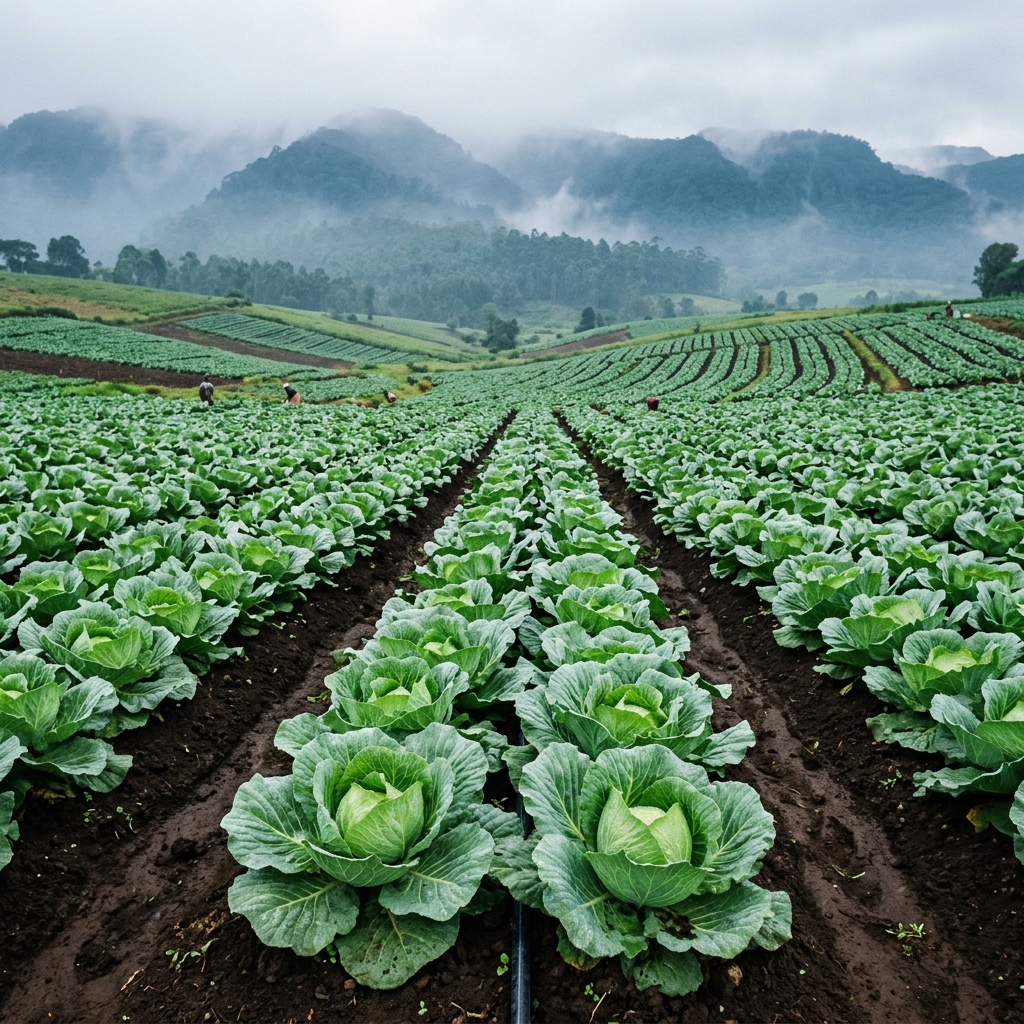
Why Kiambu leads Kenya's cabbage production
Three factors combine to make Kiambu uniquely suited to commercial cabbage production, and all three are structural — they cannot be easily replicated by lowland counties regardless of input spend.
Kiambu's altitude range of 1,500 to 2,100 metres keeps average temperatures between 14 and 22 degrees Celsius — below the optimal reproduction range of many cabbage pests. Diamondback moth populations, which devastate cabbage in warmer lowland counties, cycle more slowly at Kiambu altitudes, reducing insecticide frequency and cost.
Kiambu receives 900 to 1,100 mm of rainfall annually across two seasons, distributed relatively evenly. The Aberdare catchment creates reliable moisture that reduces irrigation infrastructure needs — a significant capital saving compared to drier counties where cabbage requires drip or sprinkler systems to be viable.
Kiambu cabbage reaches Wakulima Market in Nairobi within two hours of harvest. This eliminates the post-harvest deterioration that erodes margins for farmers in more distant counties. A Kiambu farmer can wait for market prices to rise before harvesting and respond within the same day — a market advantage that distance removes entirely.
Kiambu soil data and the pH problem
ShambaIQ's high-resolution soil mapping shows a consistent pattern across Kiambu's highland sub-counties: soils are nitrogen-rich and have adequate organic carbon, but pH is systematically too low for optimal cabbage production. Cabbage belongs to the brassica family and is more sensitive to soil acidity than most food crops — it needs pH above 6.0 to absorb calcium and boron, and above 6.5 to suppress clubroot disease spore germination.
| Nutrient | Kiambu average | Cabbage optimum | Status | Action required |
|---|---|---|---|---|
| Soil pH | 4.8 – 5.8 | 6.0 – 7.0 | Acidic — Critical | Dolomitic lime essential |
| Total Nitrogen (g/kg) | 2.0 – 3.2 | > 1.5 g/kg | Good | DAP + CAN programme sufficient |
| Phosphorus (mg/kg) | 6 – 15 | > 15 mg/kg | Deficient | DAP at transplanting non-negotiable |
| Potassium (mg/kg) | 80 – 160 | > 120 mg/kg | Low – Adequate | Monitor — supplement if below 100 |
| Calcium (mg/kg) | 200 – 500 | > 1000 mg/kg | Deficient | Corrected by dolomitic lime application |
| Organic Carbon (g/kg) | 18 – 30 | > 15 g/kg | Good | Maintain with crop residue retention |
Source: ShambaIQ precision soil mapping, 0 to 20 cm depth, Kiambu County average. Get your farm-specific reading here.
The pH Crisis Across Kiambu Highlands
At pH 4.8 to 5.4 — which covers significant portions of Limuru, Lari, and upper Githunguri — cabbage cannot access calcium regardless of how much fertilizer is applied. Calcium is immobile in the plant: once a leaf is formed without adequate calcium, tip burn cannot be corrected by foliar sprays. The entire leaf is lost. At the same pH range, aluminium and manganese become soluble and reach toxic concentrations in soil water, directly damaging root tips and blocking water uptake. Lime is not optional for these soils. It is the precondition for everything else.
Lime application guide for Kiambu soils
Dolomitic lime is the preferred product for Kiambu highland soils because it supplies both calcium and magnesium — two nutrients that Kiambu's heavily leached soils are deficient in simultaneously. Calcitic lime supplies only calcium and will not correct magnesium deficiency, which manifests as interveinal chlorosis in older cabbage leaves.
| Current soil pH | Lime rate per acre | Product | Timing | Expected pH after |
|---|---|---|---|---|
| Below 5.0 | 2,000 kg (2 tonnes) | Dolomitic lime | 6 weeks before transplanting | 5.8 – 6.2 |
| 5.0 – 5.4 | 1,500 kg (1.5 tonnes) | Dolomitic lime | 4 weeks before transplanting | 5.8 – 6.3 |
| 5.5 – 5.9 | 750 – 1,000 kg | Dolomitic lime | 3 weeks before transplanting | 6.2 – 6.6 |
| 6.0 – 6.4 | 500 kg maintenance | Dolomitic lime | Once per year after harvest | Maintain above 6.0 |
| Above 6.5 | No lime needed | — | Recheck after two seasons | Monitor only |
Never Apply Lime and DAP Together
Lime and DAP applied simultaneously in the same soil volume react chemically — calcium from the lime combines with phosphate from DAP to form insoluble calcium phosphate that neither plant roots nor soil microbes can access. The phosphorus is locked out entirely. Apply lime first, wait at least three weeks, then apply DAP at transplanting. This sequencing is non-negotiable.
Clubroot — the disease that destroys silently
Clubroot (Plasmodiophora brassicae) is a soil-borne pathogen that infects brassica roots at the seedling stage, forming galls that block water and nutrient uptake while remaining invisible above ground until irreversible damage has occurred. By the time a Kiambu cabbage farmer sees wilting, yellowing, and stunted growth in the field, the root system is already destroyed.
The pathogen thrives specifically in the conditions common across Kiambu: cool temperatures, high soil moisture, and — critically — acidic soil below pH 6.5. Raising soil pH above 6.5 through lime application does not kill clubroot spores, but it suppresses their germination and infection rate by over 80 percent. This is why lime is both a soil correction and a disease prevention tool simultaneously.
Four-Point Clubroot Prevention Protocol
Raise pH above 6.5
Apply dolomitic lime at rates shown above, at least three to six weeks before transplanting. pH above 6.5 suppresses clubroot infection by over 80 percent.
Implement a three-year brassica-free rotation
Rotate through maize, beans, or potatoes for three seasons before returning to any brassica crop (cabbage, kale, broccoli, sukuma wiki, cauliflower). Clubroot spores survive in soil for up to 20 years but require a host to reproduce.
Use clean transplanting equipment between fields
Clubroot spreads on soil particles attached to tools, boots, and transplanting trays. Wash equipment with clean water and allow to dry completely before moving between fields. Never share seedling trays between farms.
Source seedlings from a certified clubroot-free nursery
Most clubroot introductions into new fields come from infected nursery seedlings. Buy from nurseries that can show clean soil test results. Raise your own seedlings in sterilised growing media where possible.
Best certified cabbage varieties for Kiambu
Variety choice in Kiambu must balance maturity period, head weight, market preference, and disease tolerance. The Nairobi fresh market prefers round, dense heads of 1.5 to 2.5 kg. Processors and institutions favour larger heads above 3 kg. Both markets exist within Kiambu's reach.
Gloria F1
Most popular in Kiambu for Nairobi fresh market. Dense, round head. Good field-holding ability — can stay in field 2 weeks after maturity without splitting.
Star 3301 F1
Tolerant to black rot. Slightly larger than Gloria. Preferred by Kiambu farmers targeting Wakulima wholesale buyers who pay per head rather than per kg.
Farakalla F1
Large-headed, dense. Preferred by institutions and processors. Longer season means higher production cost but premium price per head from bulk buyers.
Pruktor F1
Strong outer wrapper leaves reduce post-harvest damage during transport. Good for farms further from Nairobi where handling time is longer.
Three-stage fertilizer programme for Kiambu cabbage
Cabbage has a higher nitrogen demand than maize but requires it in a staged programme that tracks the crop's growth phases. Front-loading all nitrogen at transplanting produces excessive leaf growth, delays head formation, and produces loose, unmarketable heads. The three-stage programme below synchronises nutrient delivery with crop demand.
Stage 1 — At transplanting
Apply DAP in the planting hole, covered with soil before placing the seedling. DAP provides phosphorus for root establishment and early shoot development. Do not substitute with CAN or urea at this stage — nitrogen without phosphorus at planting produces poor root architecture that limits the entire season's potential.
Stage 2 — At three weeks
Apply CAN in a ring 10 cm from the stem. This drives the rapid leaf expansion phase. Leaf number and leaf area at this stage directly determines the photosynthetic capacity available for head formation. A poorly fertilized plant at three weeks produces a small, loose head regardless of what happens later.
Stage 3 — At six weeks
Apply a second CAN top-dressing as head formation begins. This fuels the cell division and compaction that creates a dense, heavy, marketable head. Do not apply additional nitrogen after this point — it delays maturity and softens head texture, reducing shelf life and market value.
Supplemental — At four weeks
Spray a soluble boron foliar across the entire canopy. Boron deficiency is endemic in Kiambu's leached highland soils and causes hollow stem syndrome and tip burn — two quality defects that cannot be corrected once they appear. This single application costs approximately KES 300 per acre and eliminates a major quality risk.
Planting calendar for Kiambu county
Kiambu's bimodal rainfall supports two main cabbage planting windows. The long rains season produces the highest volumes and lowest prices at Nairobi markets. Farmers who time planting for the short rains often achieve better prices due to reduced market supply from other counties.
| Season | Sow nursery | Transplant | Harvest window | Market outlook |
|---|---|---|---|---|
| Long Rains | Late January | Late February – March | May – June | High supply, competitive prices. Volume is key. |
| Short Rains | Late August | Late September – October | December – January | Lower supply, stronger prices. Target this window. |
Step-by-step: growing cabbage in Kiambu county
- 1
Test soil pH and order lime three weeks before transplanting
Use ShambaIQ at shambaiq.com/app?county=kiambu&crop=cabbage to get your farm's soil pH reading. If pH is below 6.0 — which covers most of Limuru and upper Githunguri — order dolomitic lime immediately. Lime must be incorporated into the soil at least three weeks before transplanting to begin raising pH. Transplanting into uncorrected acidic soil is the single most common reason cabbage fails in Kiambu highland farms.
- 2
Incorporate dolomitic lime and prepare beds
Broadcast dolomitic lime evenly across the entire planting area and work it into the top 20 cm of soil using a fork or rotovator. Do not apply lime and DAP at the same time — lime reacts with phosphorus and reduces its availability. Apply lime, wait three weeks, then apply DAP at transplanting. Prepare raised beds 1 metre wide with 60 cm pathways to improve drainage on Kiambu's high-rainfall highland soils.
- 3
Raise seedlings in a nursery for 25 to 30 days
Sow cabbage seed in a nursery bed at 10 g per square metre, covered with a thin layer of fine soil. Water daily and apply a light fungicide drench (metalaxyl) at 10 days to prevent damping-off. Seedlings are ready for transplanting when they reach 10 to 15 cm height with four to five true leaves. Harden seedlings by reducing water for three days before transplanting.
- 4
Transplant at correct spacing with DAP in the hole
Transplant seedlings at 60 cm between rows and 45 cm within rows in the late afternoon or on a cloudy day to reduce transplant shock. Place a tablespoon of DAP (approximately 5 g) in each planting hole, covered with a thin soil layer before placing the seedling. Water immediately after transplanting. Avoid transplanting into waterlogged soil — root oxygen stress at this stage causes permanent stunting.
- 5
Apply first CAN top-dressing at three weeks
Apply CAN at 50 kg per acre in a ring 10 cm from the stem at three weeks after transplanting. This drives the rapid leaf expansion phase that determines final head size. Water after application if rainfall is not expected within 24 hours — CAN needs moisture to dissolve and reach the root zone.
- 6
Apply boron foliar spray at four weeks
Spray a soluble boron product (borax at 1 g per litre or a commercial boron foliar) at four weeks after transplanting. Boron deficiency is common in Kiambu's leached highland soils and causes hollow stem, tip burn, and failure of the head to form densely. This is a low-cost intervention — one foliar application per season at approximately KES 300 per acre — that significantly improves head quality.
- 7
Apply second CAN top-dressing at six weeks
Apply a second CAN top-dressing at 50 kg per acre at six weeks, when the head is beginning to form. Do not apply additional nitrogen after this point. Late nitrogen application delays maturity, softens heads, and increases susceptibility to post-harvest rot — a particular risk given Kiambu's high humidity.
- 8
Scout for pests weekly and harvest at correct maturity
Scout weekly for diamondback moth (look for windowed leaves), aphids (check the inner leaves of forming heads), and black rot (yellow V-shaped lesions from leaf margins). Harvest when heads feel firm under hand pressure and before splitting occurs. Harvesting at 90 to 95 percent maturity reduces field losses significantly in Kiambu's wet conditions.
Cost and revenue budget per acre — Kiambu cabbage 2026
| Item | Qty | Unit cost (KES) | Total (KES) |
|---|---|---|---|
| Certified seedlings (Gloria F1 or Star 3301) | 14,800 plants | 2 | 29,600 |
| Dolomitic lime (50 kg bags) | 20 bags (1,000 kg) | 700 | 14,000 |
| DAP fertilizer (50 kg bag) | 1 bag | 3,800 | 3,800 |
| CAN fertilizer (50 kg bag x2) | 2 bags | 3,200 | 6,400 |
| Foliar boron | 1 application | 300 | 300 |
| Fungicide (metalaxyl) | 2 applications | 1,200 | 2,400 |
| Insecticide (diamondback moth) | 3 applications | 900 | 2,700 |
| Labour — land prep and liming | 3 days | 500 | 1,500 |
| Labour — transplanting | 4 days | 500 | 2,000 |
| Labour — weeding and spraying | 6 days | 500 | 3,000 |
| Labour — harvest and transport | 4 days | 500 | 2,000 |
| TOTAL INPUT COST | KES 67,700 | ||
| Expected revenue (20 t x KES 18/kg at Wakulima) | KES 360,000 | ||
| Net margin | KES 292,300 | ||
Lime cost assumes pH 5.5 to 5.9 requiring 1,000 kg per acre. Higher-acidity farms will have higher lime costs in Year 1 but lower maintenance rates thereafter. Seedling cost assumes purchase from a certified Kiambu nursery. Find Kiambu agrovets and current input prices here.
Free Precision Tool
Check Kiambu Soil Suitability: Calculate your lime dosage before planting at ShambaIQ Kiambu Cabbage Advisor.
ShambaIQ gives you your Kiambu farm's exact soil pH, phosphorus status, and calcium levels — and calculates the precise lime dosage and fertilizer programme before you spend anything on inputs. Free. No sign-up required.
Open Kiambu Cabbage Advisor