Maize farming in Nakuru county:A precision guide to maximum yields
Nakuru County sits at the heart of Kenya's maize belt. Its loam soils, reliable bimodal rainfall, and altitude range of 1,700 to 2,400 metres create near-ideal conditions for maize production. Yet the average smallholder here harvests barely half of what the same farm is capable of producing. The gap is not rainfall, not seed, not labour. It is precision: applying the right fertilizer, at the right amount, at the right time, based on what the soil actually contains.
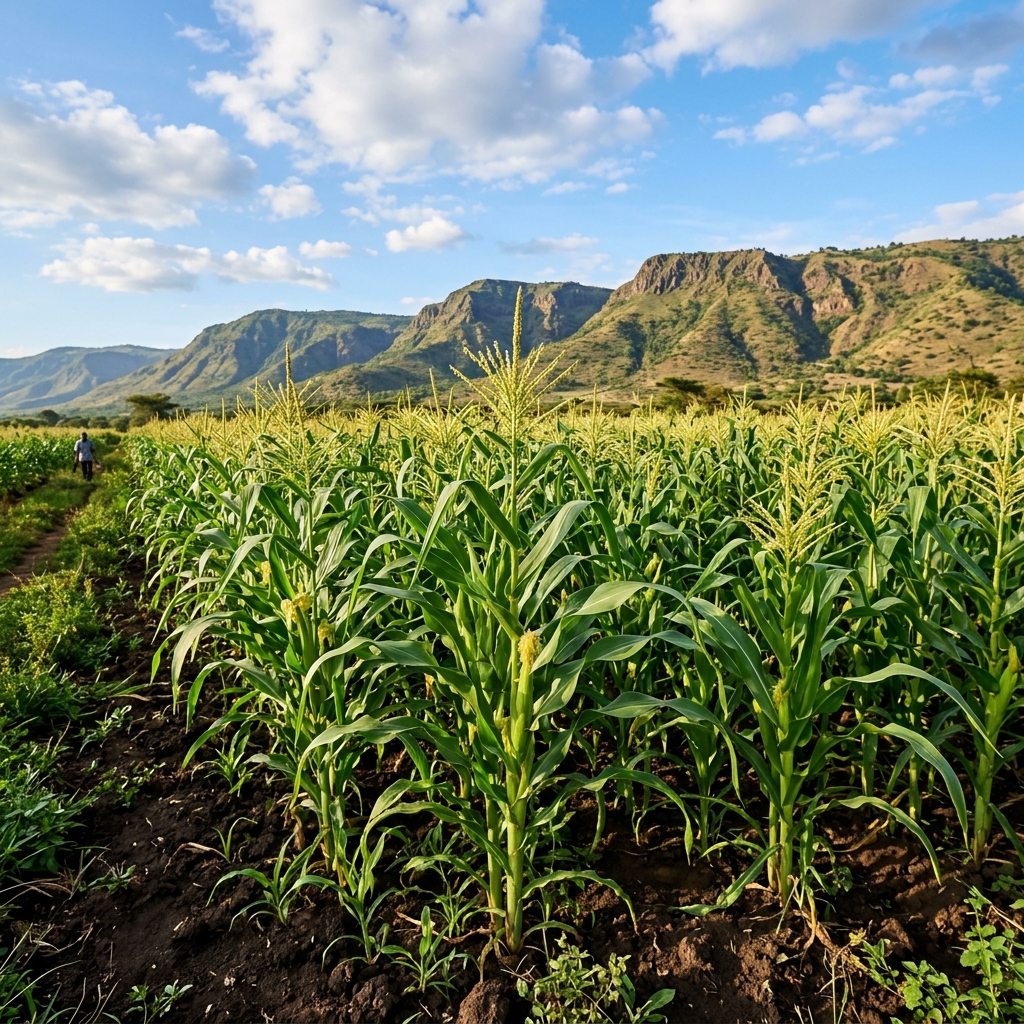
Why Nakuru is Kenya's maize heartland
Kenya produces approximately 3.6 million tonnes of maize annually, and the Rift Valley region — anchored by Nakuru — accounts for nearly a quarter of national output. Nakuru's position is not accidental. The county combines four structural advantages that few Kenyan counties can match simultaneously.
Nakuru's dominant soil type is a sandy clay loam derived from volcanic parent material. These soils hold applied fertilizer efficiently — draining enough to prevent waterlogging but retaining moisture long enough for roots to absorb nutrients between rainfall events.
Two reliable rain seasons — long rains from February to May and short rains from September to November — allow two maize crops per year in most of Nakuru. The Molo and Njoro highlands receive the higher end of this range.
Nakuru's 1,700 to 2,400 metre altitude range aligns precisely with the optimal conditions for Kenya's highest-yielding certified hybrids including H614D and DK8031, which consistently outperform varieties used in lowland counties.
Proximity to the Nakuru grain market, NCPB depot access, and road connections to Nairobi give Nakuru farmers negotiating power that remote counties lack. Dried maize at 13 percent moisture commands premium prices from millers who prefer Rift Valley grain.
Nakuru soil data and what it means for maize
ShambaIQ uses county-average soil measurements sourced from its regional baseline model to generate nutrient baselines across all 47 counties. For field-level precision, use the GPS farm mapping tool. Here is what the data shows for Nakuru county, mapped against maize's agronomic requirements:
| Nutrient | Nakuru average | Maize optimum | Status | Implication |
|---|---|---|---|---|
| Soil pH | 6.0 – 6.8 | 5.8 – 7.0 | Optimal | No lime needed in most farms |
| Total Nitrogen (g/kg) | 1.4 – 2.1 | > 1.5 g/kg | Adequate – Low | CAN top-dressing always required |
| Phosphorus (mg/kg) | 12 – 28 | > 20 mg/kg | Marginal – Good | DAP at planting non-negotiable |
| Potassium (mg/kg) | 180 – 320 | > 100 mg/kg | Sufficient | No K supplement needed |
| Organic Carbon (g/kg) | 15 – 25 | > 12 g/kg | Good | Maintain with crop residue retention |
Source: ShambaIQ precision soil mapping, 0 to 20 cm depth, Nakuru County average. Farm-level values vary by sub-location. Get your exact farm reading here.
The Key Insight for Nakuru Maize Farmers
Phosphorus is the variable nutrient in Nakuru. At 12 mg/kg in lower-rainfall sub-locations, DAP underdosing directly limits root development. At 28 mg/kg in high-organic-matter Molo soils, DAP rates can be reduced without yield penalty. This 2.3-fold range is why a county-average recommendation is less accurate than a farm-level one.
Certified variety selection by sub-location
A certified hybrid on well-fertilized Nakuru soil consistently yields 25 to 35 bags per acre. The same soil with recycled seed yields 10 to 15 bags regardless of fertilizer input. The genetics set the ceiling — choose accordingly.
H614D
Best for Molo, Njoro, and Kuresoi highlands. Tolerant to grey leaf spot common at high altitude.
DK8031
Strong stalk, wind-resistant. Preferred in Rongai and Subukia where wind damage is common.
Pioneer PH1
Earlier maturity suits the shorter short-rains season. Good for Nakuru Town environs and Naivasha north.
H513
Short-season for Naivasha basin and lower Gilgil. Not suitable above 2,000 m.
Always purchase from a KEPHIS-registered agrovet and verify the lot number on the KEPHIS website. Counterfeit seed is a documented problem in Nakuru — it looks identical to certified seed but contains no genetic improvement and often carries pathogen contamination.
The precision fertilizer programme for Nakuru maize
Nakuru soils need two fertilizer applications per season. The basal application at planting builds root architecture. The top-dressing at knee height drives rapid vegetative growth and grain fill. Skipping either application cuts yield by 30 to 45 percent.
| Application | Fertilizer | Rate per acre | Timing | Placement |
|---|---|---|---|---|
| Basal (standard soil) | DAP 18:46:0 | 1 bag (50 kg) | At planting | In furrow, covered before seed |
| Basal (P-deficient soil) | DAP 18:46:0 | 1.5 bags (75 kg) | At planting | In furrow, covered before seed |
| Alternative basal | NPK 23:21:0 | 1 bag (50 kg) | At planting | In furrow, covered before seed |
| Top-dressing | CAN 26% | 1 bag (50 kg) | Knee height (4–6 wks) | Ring 10 cm from stem |
NPK 23:21:0 vs DAP — Which to Choose in Nakuru?
Both work well on Nakuru loam soils. NPK 23:21:0 provides nitrogen at planting alongside phosphorus, giving a slight early growth advantage. DAP provides more phosphorus per bag, making it the better choice when ShambaIQ shows phosphorus below 15 mg/kg. At current Nakuru agrovet prices, DAP is typically 200 to 400 KES cheaper per bag.
Planting calendar for Nakuru county
| Season | Land prep | Plant | Top-dress | Harvest | Best variety |
|---|---|---|---|---|---|
| Long Rains | Jan – Feb | Late Feb – Mid March | April | June – July | H614D, DK8031 |
| Short Rains | Aug – Sep | Late Sep – Early Oct | November | Jan – Feb | Pioneer PH1, H513 |
Weed and pest management in Nakuru maize
Weed competition in the first six weeks after planting can reduce yields by 40 to 60 percent independent of fertilizer. On Nakuru's productive loam soils, weeds grow as aggressively as the crop. Three management windows matter.
Pre-emergence herbicide
Apply Atrazine 80WP at 2 kg per acre on moist soil within 72 hours of planting. This suppresses broadleaf weeds and grasses during the critical first six weeks of establishment.
Post-emergence weeding
If pre-emergence failed due to dry weather, hand weed thoroughly at weeks 3 to 4 before canopy closure. Post-emergence options include Callisto plus Atrazine mix for broadleaf control without damaging the maize plant.
Fall armyworm scouting
Check 20 plants per acre weekly. At 10 percent infestation apply emamectin benzoate (Escort or equivalent) directed into the whorl early morning or evening. Resistance to older pyrethroids is now widespread in Nakuru — do not use lambda-cyhalothrin as a first-line treatment.
Step-by-step: growing maize in Nakuru county
- 1
Run your soil check before buying inputs
Use ShambaIQ at shambaiq.com/app to pull precision soil data for your exact farm location. Nakuru soils vary significantly between Rongai, Molo, and Naivasha — a plan built for one sub-location can be wrong for another.
- 2
Prepare land two weeks before planting
Plough to 20 to 25 cm depth at least two weeks before planting to allow residue to break down. Plant when soil at 10 cm depth holds moisture without being waterlogged.
- 3
Apply basal fertilizer at planting
Apply DAP or NPK 23:21:0 at one bag (50 kg) per acre directly into the planting furrow, covered by a thin soil layer before placing the seed. Never allow fertilizer to touch the seed directly.
- 4
Plant certified hybrid seed at correct spacing
Plant at 75 cm between rows and 25 cm within rows, two seeds per hole thinned to one at two weeks. This gives approximately 53,000 plants per acre — the population needed to fully use the fertilizer applied.
- 5
Apply pre-emergence herbicide within 72 hours
Apply Atrazine 80WP at 2 kg per acre on moist soil within 72 hours of planting. This suppresses broadleaf weeds and grasses during the critical first six weeks of establishment.
- 6
Top-dress with CAN at knee height
Apply CAN at one bag (50 kg) per acre when maize reaches 30 to 40 cm height, approximately four to six weeks after planting. Place CAN in a ring 10 cm from the stem — not against the stem.
- 7
Scout for fall armyworm weekly from week 3
Check 20 plants per acre weekly. At 10 percent infestation apply emamectin benzoate directed into the whorl early morning or evening. Act within 48 hours of visible damage.
- 8
Harvest at correct moisture
Harvest when grain moisture is below 20 percent, typically 120 days after planting. Dry to below 13 percent before bagging for storage or sale to avoid aflatoxin contamination.
Full cost and revenue budget per acre — Nakuru 2026
| Item | Qty | Unit cost (KES) | Total (KES) |
|---|---|---|---|
| Certified hybrid seed (2 kg pack) | 1 | 1,200 | 1,200 |
| DAP fertilizer (50 kg bag) | 1 | 3,800 | 3,800 |
| CAN fertilizer (50 kg bag) | 1 | 3,200 | 3,200 |
| Pre-emergence herbicide | 2 kg | 600 | 1,200 |
| Insecticide (armyworm) | 500 ml | 800 | 800 |
| Labour — land preparation | 1 tractor day | 1,500 | 1,500 |
| Labour — planting and fertilizing | 3 days | 500 | 1,500 |
| Labour — weeding | 4 days | 500 | 2,000 |
| Labour — harvest and shelling | 4 days | 500 | 2,000 |
| TOTAL INPUT COST | KES 17,200 | ||
| Expected revenue (30 bags x KES 3,500) | KES 105,000 | ||
| Net margin | KES 87,800 | ||
Prices are indicative 2026 Nakuru market rates. Yield assumes certified hybrid seed and full fertilizer programme. Find Nakuru agrovets and current input prices here.
Free Precision Tool
Optimize Your Yield: Get a tailored fertilizer budget instantly. Use the ShambaIQ Precision Tool for Nakuru Maize.
ShambaIQ calculates your exact fertilizer bags, application timing, and KES cost per acre based on your farm's precise soil data. Built for Nakuru County. Free. No sign-up required.
Open Nakuru Maize Advisor