Tomato farming in Kirinyaga: Maximizing yields on Mwea's black cotton soils
The Mwea irrigation scheme in Kirinyaga County is one of Kenya's most productive agricultural zones — and one of its most technically demanding environments for tomato production. The same black cotton soils that retain irrigation water so efficiently also create two compounding problems that most Kirinyaga farmers have never been told to connect: calcium mobility blockage that causes blossom end rot, and root oxygen depletion that invites late blight. Solve both and Kirinyaga's tomato potential is exceptional. Ignore either and the season becomes a cycle of losses that feels like bad luck but is actually predictable soil chemistry.
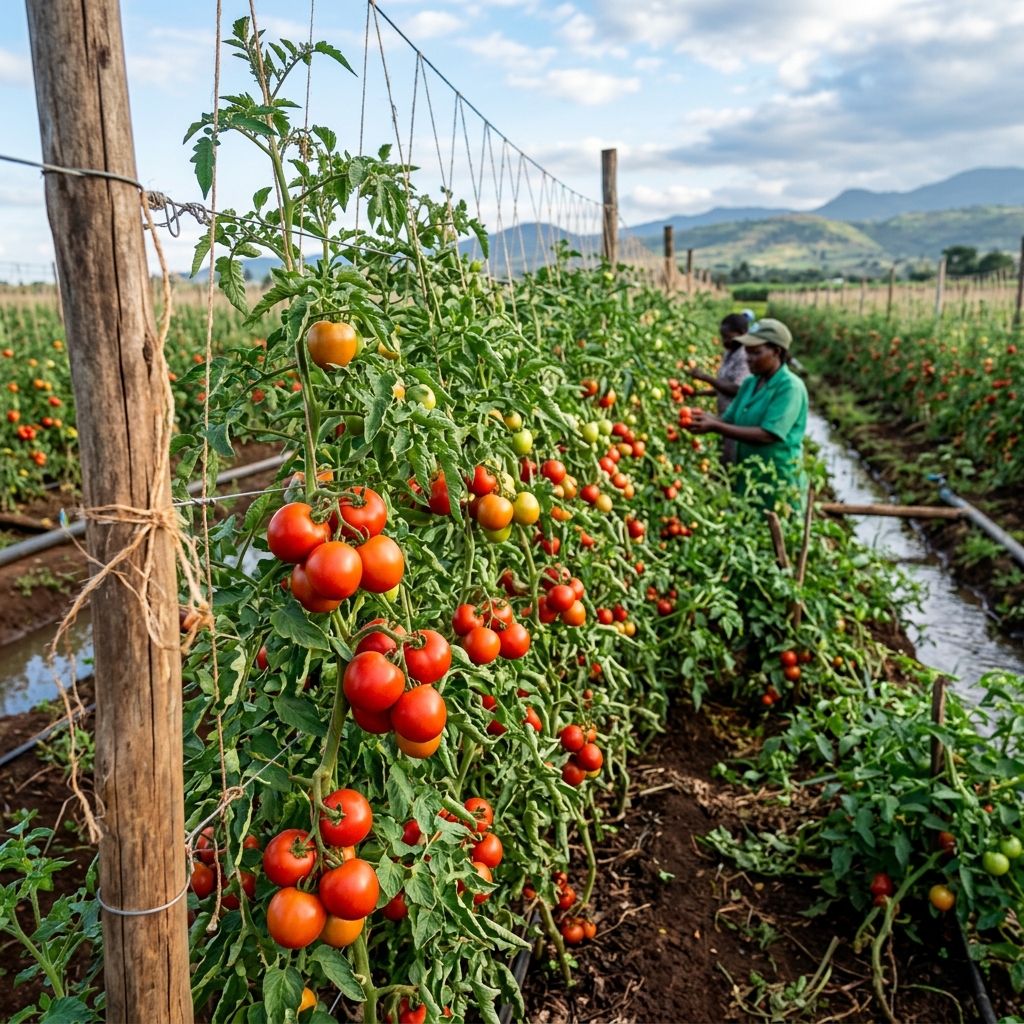
Why Kirinyaga is Central Kenya's tomato hub
Kenya's tomato production is concentrated in a handful of counties, and Kirinyaga — specifically the Mwea irrigation scheme — plays an outsized role in supplying Nairobi's wholesale markets year-round. Three structural factors explain this concentration.
Unlike rain-fed counties where tomato production is seasonal, the Mwea irrigation scheme's canal network allows farmers to plant in any month and produce two to three tomato cycles per year. Year-round production smooths income, allows farmers to time harvests to high-price windows, and provides banks and input suppliers with the repayment reliability needed to extend seasonal credit.
Kirinyaga's Mwea lowlands sit at 1,000 to 1,200 metres above sea level — significantly warmer than highland tomato-growing counties like Kiambu or Nyeri. This warmth shortens the season from transplanting to first harvest from 75 to 90 days in the highlands to 60 to 75 days in Mwea, allowing an additional crop cycle per year on the same land.
Kirinyaga County lies 120 kilometres from Nairobi on a tarmac road — close enough for overnight transport delivering fresh tomatoes to Wakulima Market by early morning trading. This transport window is critical: tomatoes harvested at the breaker stage in the evening reach Nairobi in marketable condition. Counties more than 200 kilometres from Nairobi cannot reliably achieve this.
Black cotton soils — understanding the challenge
Black cotton soils — technically called vertisols — dominate the Mwea irrigation scheme and much of Kirinyaga's lowland area. They are visually impressive soils: dark, heavy, and rich in organic matter. But their physical behaviour under irrigation makes them one of the most demanding substrates for tomato production in Kenya.
What black cotton does well
- +High water retention — holds moisture between irrigations
- +Rich in calcium, magnesium, and potassium by total analysis
- +Good organic matter content supports soil biology
- +High clay content buffers pH fluctuations
What black cotton does poorly
- -Very low permeability — waterlogging occurs rapidly
- -Swells when wet, cracks when dry — physical root stress
- -Calcium mobility blocked when soil is saturated
- -High magnesium competes with calcium uptake above pH 7.0
The management strategy for Kirinyaga tomatoes is built around compensating for exactly these weaknesses: raised beds to solve permeability, drip irrigation to solve waterlogging, and calcium nitrate to solve mobility blockage. Each intervention addresses a specific black cotton limitation rather than generic tomato advice.
Blossom end rot — the calcium problem explained
Blossom end rot (BER) is the single most common yield-reducing problem in Kirinyaga tomato production. It appears as a water-soaked, darkening, and eventually leathery patch on the blossom end of developing fruit — making it unmarketable regardless of size or external condition. Most farmers diagnose it as a disease and spray fungicides. It is not a disease. It is a calcium deficiency disorder, and fungicides have zero effect on it.
The physiology behind blossom end rot
Calcium moves through the plant exclusively via the xylem — the water-conducting tissue — driven by transpiration from leaves. It cannot be loaded into the phloem or redistributed from older tissues. Rapidly expanding fruit tissue transpires very little compared to leaves, so it competes poorly for the limited calcium stream. When calcium supply to the root is interrupted — by waterlogging that reduces root function, by high magnesium competition at elevated pH, or by irregular irrigation — the developing fruit tip is the first tissue to become calcium deficient. The cell walls collapse and the tissue dies. This damage is irreversible once it begins.
In Kirinyaga's black cotton soils, three simultaneous factors combine to create ideal BER conditions:
Irrigation waterlogging reduces root oxygen
When black cotton soil saturates, soil oxygen drops to near zero within hours. Root cells switch from aerobic to anaerobic respiration, energy production drops, and active ion transport — including calcium uptake — shuts down. Even 24 hours of waterlogging can interrupt calcium supply enough to trigger BER in fruit that began forming before the waterlogging event.
High pH above 7.0 increases magnesium competition
In Mwea's irrigated soils, pH frequently rises above 7.0 due to bicarbonate accumulation from canal water. At this pH, magnesium becomes strongly available and competes directly with calcium at root uptake sites. High magnesium-to-calcium ratios in the soil solution reduce calcium uptake efficiency even when total calcium is adequate.
Rapid fruit expansion outpaces calcium supply
Tomato fruit cells divide and expand very rapidly during the first three weeks after fruit set. The calcium demand during this period exceeds what can be supplied through transpiration-driven xylem flow even under good soil conditions. In black cotton soils with the two additional constraints above, the deficit becomes severe.
Kirinyaga soil data for tomatoes
ShambaIQ's precision soil mapping shows the following nutrient profile for Kirinyaga County's Mwea lowland area, mapped against tomato's agronomic requirements:
| Nutrient | Mwea average | Tomato optimum | Status | Action |
|---|---|---|---|---|
| Soil pH | 6.8 – 7.4 | 6.0 – 6.8 | High | Monitor — gypsum if above 7.2 |
| Total Nitrogen (g/kg) | 1.6 – 2.4 | > 1.5 g/kg | Adequate | NPK at transplant, CaN top-dress |
| Phosphorus (mg/kg) | 10 – 22 | > 15 mg/kg | Marginal | NPK 17:17:17 at planting |
| Potassium (mg/kg) | 250 – 450 | > 200 mg/kg | Good | No K supplement needed |
| Calcium (mg/kg) | 800 – 1,800 | > 1,000 mg/kg | Adequate – High total | Mobility blocked — CaN essential |
| Organic Carbon (g/kg) | 18 – 28 | > 15 g/kg | Good | Retain crop residues |
Source: ShambaIQ precision soil mapping, 0 to 20 cm depth, Kirinyaga County Mwea lowland average. Get your farm-specific calcium and pH reading here.
Best tomato varieties for Mwea conditions
Variety selection for Kirinyaga must prioritise heat tolerance, humidity resistance, and virus tolerance — the three environmental stresses that distinguish Mwea's lowland conditions from highland tomato zones.
Kilele F1
Determinate hybrid
Top choice for Mwea commercial growers. Excellent tolerance to tomato yellow leaf curl virus (TYLCV) transmitted by Bemisia tabaci whitefly. Firm fruit with long shelf life preferred by Nairobi buyers.
Cal-J F1
Determinate hybrid
Highest yield potential of the recommended varieties. Strong tolerance to late blight. Large, uniform fruit with good colour — preferred for processing and export. Higher seed cost offset by superior yield.
Rio Grande
Determinate OPV
Open-pollinated variety. Lower seed cost allows self-saving across seasons. Moderate late blight resistance. Suitable for farmers transitioning to commercial tomato production before investing in F1 hybrid costs.
Tengeru 97
Determinate OPV
Developed in Tanzania specifically for East African conditions. Good adaptation to Mwea's humidity. Less virus tolerance than F1 hybrids but reliable performance under standard pest management.
Three-stage calcium fertilizer programme
The fertilizer programme for Kirinyaga tomatoes is designed around the calcium mobility constraint of black cotton soils. Every stage either builds the soil phosphorus foundation, delivers continuous calcium through the fruiting window, or maintains nitrogen for steady growth without the excess that increases disease susceptibility.
Stage 1 — At transplanting
Balanced NPK in the planting hole establishes the root system with equal phosphorus and potassium alongside a moderate nitrogen dose. Phosphorus drives root architecture in the first three weeks — a deep, well-branched root system is the primary defence against BER because it accesses a larger soil calcium pool. Do not use straight urea or CAN at transplanting — nitrogen without phosphorus at this stage produces weak roots that underperform through the entire season.
Stage 2 — At first flower
Switch entirely to calcium nitrate (Yara Winner, Haifa Cal, or equivalent) as the first flowers open. This delivers calcium directly to the root zone precisely as fruit cells begin dividing. The nitrogen component of calcium nitrate (approximately 15 percent N) continues supporting vegetative growth without excess. Do not use pure CAN (calcium ammonium nitrate) — despite the name it contains only 8 percent calcium oxide, insufficient to prevent deficiency on black cotton soils.
Stage 3 — Every 3 weeks through harvest
Continue calcium nitrate applications every three weeks from first fruit set through the final harvest. Each application maintains the calcium supply to the continuous succession of fruit trusses forming above the earlier ones. Stopping calcium nitrate after the first truss sets leaves subsequent trusses without calcium support and guarantees BER on the second and third picks — the highest-volume harvest windows.
Supplemental — Foliar calcium if BER appears
If blossom end rot appears despite the programme, spray calcium chloride at 4 g per litre directly on developing fruit trusses in the early morning. Foliar calcium is absorbed through the fruit skin and provides rapid but temporary supplementation. It does not replace soil calcium nitrate — it buys time while root uptake is corrected by addressing the underlying waterlogging or irrigation irregularity causing the deficiency.
Late blight and virus management in Kirinyaga
Beyond blossom end rot, Kirinyaga tomato farmers face two significant biological threats that require active management throughout the season.
Late blight (Phytophthora infestans)
High riskMwea's warm, humid conditions and frequent overhead irrigation create near-ideal conditions for late blight. Lesions appear as water-soaked patches on leaves and stems that rapidly turn brown and produce white sporulation on the underside in humid conditions. A single infected plant can spread to the entire field within five to seven days. Management requires preventive copper fungicide every 7 to 10 days, drip irrigation to avoid wetting foliage, and single-stem training for canopy airflow.
- →Copper oxychloride 2.5 g/L every 7 to 10 days preventively
- →Switch to metalaxyl 2 g/L at first symptom appearance
- →Drip irrigation only — no overhead sprinklers
- →Remove and destroy infected plant material immediately
Tomato yellow leaf curl virus (TYLCV)
Moderate riskTYLCV is transmitted by the whitefly Bemisia tabaci and causes severe stunting, leaf yellowing, and fruit deformation with no curative treatment. Once infected, plants must be removed to prevent spread to healthy plants. Management focuses entirely on whitefly control and using TYLCV-tolerant varieties. Kilele F1 and Cal-J F1 carry the Ty gene for virus tolerance — this single trait justifies their premium seed cost in Kirinyaga's whitefly-prone environment.
- →Plant TYLCV-tolerant varieties (Kilele F1, Cal-J F1)
- →Apply systemic insecticide (imidacloprid) at transplanting
- →Use yellow sticky traps to monitor whitefly populations
- →Remove and destroy any stunted, yellowing plants immediately
Step-by-step: growing tomatoes in Kirinyaga county
- 1
Assess soil calcium and pH before transplanting
Use ShambaIQ at shambaiq.com/app to check your farm's calcium status and soil pH. Mwea black cotton soils frequently show pH above 7.0 in irrigated sections — at this pH magnesium competes with calcium for root uptake and blossom end rot risk is high regardless of total soil calcium. Identify whether your farm needs gypsum (calcium sulfate) as a calcium source that does not raise pH further, or calcium nitrate as the primary season programme.
- 2
Prepare raised beds to manage black cotton drainage
Prepare raised beds 30 to 40 cm high and 1 metre wide on black cotton soils. Black cotton (vertisol) soils have very low permeability and waterlog rapidly under flood irrigation. Raised beds elevate the root zone above the waterlogged layer, maintaining root oxygen and enabling calcium transport to developing fruit. Flat planting into Mwea's black cotton soils without raised beds increases blossom end rot incidence by 40 to 60 percent even with adequate calcium fertilization.
- 3
Transplant seedlings with NPK 17:17:17 in the planting hole
Transplant 25 to 30 day old seedlings in the late afternoon or on a cloudy day to reduce transplant shock. Space at 60 cm between rows and 50 cm within rows on raised beds. Place NPK 17:17:17 at one tablespoon per hole (approximately 5 g), covered with soil before placing the seedling. This balanced NPK gives equal phosphorus for root establishment and potassium for early cell development without excess nitrogen that would promote vegetative growth at the expense of fruiting.
- 4
Install drip irrigation and set moisture targets
Install drip irrigation tape at 30 cm spacing along the bed surface before planting if possible, or immediately after transplanting. Set irrigation to maintain soil moisture at 60 to 80 percent field capacity — moist but never saturated. On black cotton soils, allow the surface to dry slightly between irrigations to maintain soil aeration. Never use overhead sprinklers on Mwea tomatoes — wet foliage in Kirinyaga's humid lowland climate guarantees late blight infection within 7 to 10 days.
- 5
Apply first calcium nitrate top-dressing at flowering
Apply calcium nitrate (Yara Winner or equivalent) at 50 kg per acre when the first flowers open, approximately 25 to 30 days after transplanting. This is the most critical intervention for blossom end rot prevention. Calcium moves to fruit tissue only through the transpiration stream — it cannot be redistributed from older plant tissues once deficiency appears in developing fruit. Starting calcium nitrate at first flower ensures calcium is available in the root zone exactly when fruit cells begin dividing.
- 6
Stake plants at 30 cm height and train to single stem
Install bamboo or eucalyptus stakes (1.5 m long) at 30 cm height when plants reach 20 to 25 cm tall. Train to a single main stem by removing all lateral shoots (suckers) below the first flower truss weekly. Single-stem training in Kirinyaga's humid conditions dramatically improves canopy airflow, reduces leaf wetness duration, and lowers late blight pressure. It also concentrates the plant's energy into fruit production rather than vegetative growth.
- 7
Spray preventive copper fungicide every 7 to 10 days
Begin copper fungicide sprays (copper oxychloride at 2.5 g per litre, or copper hydroxide at 2 g per litre) from 14 days after transplanting, before any symptoms appear. Spray every 7 to 10 days through the season, increasing to every 7 days during periods of high humidity or after rainfall. Rotate to metalaxyl at 2 g per litre if late blight symptoms appear, then return to copper for the following spray. Never rely on curative treatments alone in Kirinyaga's high-humidity Mwea conditions.
- 8
Continue calcium nitrate every three weeks through harvest
Apply calcium nitrate at 30 kg per acre every three weeks from first fruit set through the final harvest. This maintains continuous calcium availability throughout the fruiting period, which spans 6 to 8 weeks from first to last pick. Harvest individual fruits when they reach the breaker stage (first colour change) for transportation to Nairobi markets — fully ripe tomatoes deteriorate within 24 hours in Mwea's heat and do not reach market in sellable condition.
Cost and revenue budget per acre — Kirinyaga tomato 2026
| Item | Qty | Unit cost (KES) | Total (KES) |
|---|---|---|---|
| Certified seedlings (Kilele F1) | 14,000 plants | 3 | 42,000 |
| NPK 17:17:17 (50 kg bag) | 1 bag | 4,200 | 4,200 |
| Calcium nitrate (Yara Winner) | 80 kg total | 5,500 | 8,800 |
| Copper fungicide (season supply) | 6 applications | 1,500 | 9,000 |
| Metalaxyl fungicide (curative backup) | 2 applications | 1,800 | 3,600 |
| Insecticide (whitefly control) | 4 applications | 900 | 3,600 |
| Bamboo stakes (1,400 stakes) | 1,400 | 20 | 28,000 |
| Drip irrigation tape | per acre | 12,000 | 12,000 |
| Labour — land prep and bed forming | 4 days | 500 | 2,000 |
| Labour — transplanting and staking | 5 days | 500 | 2,500 |
| Labour — spraying and top-dressing | 8 days | 500 | 4,000 |
| Labour — harvesting (weekly picks) | 10 days | 500 | 5,000 |
| TOTAL INPUT COST | KES 124,700 | ||
| Expected revenue (20 t x KES 30/kg at Nairobi wholesale) | KES 600,000 | ||
| Net margin | KES 475,300 | ||
Drip irrigation cost amortises over 3 to 4 seasons — Year 2 onwards input cost drops by KES 12,000. Tomato price assumes off-peak season; long rains harvest prices can drop to KES 15 to 20/kg. Find Kirinyaga agrovets and current calcium nitrate prices here.
Free Precision Tool
Prevent Blossom End Rot: Calculate your calcium top-dressing intervals using the ShambaIQ Kirinyaga Tomato Tool.
ShambaIQ checks your Kirinyaga farm's soil pH and calcium status and calculates your calcium nitrate top-dressing intervals to keep blossom end rot out of every truss. Free. No sign-up required.
Open Kirinyaga Tomato Advisor