Wheat farming in Uasin Gishu: Data-driven yield maximization on the Eldoret plateau
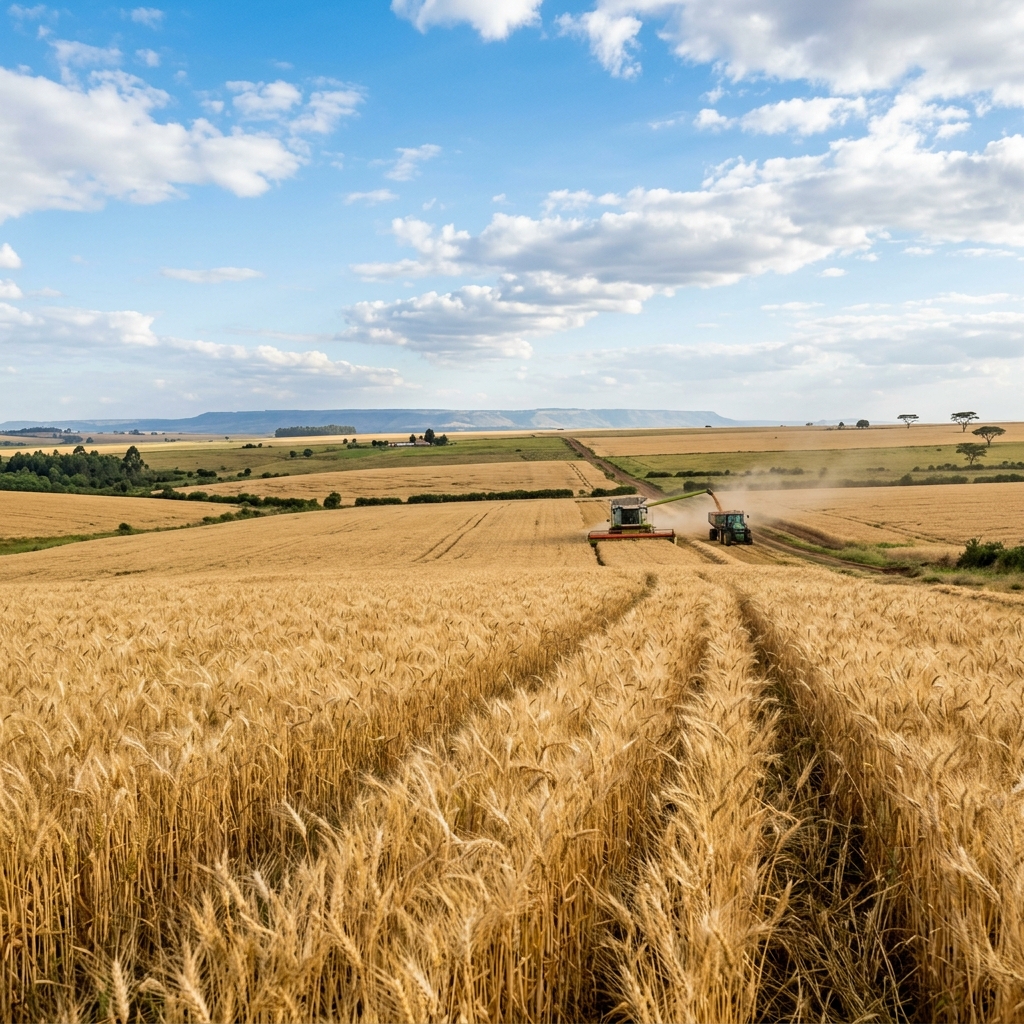
Uasin Gishu County produces more wheat than any other county in Kenya. The Eldoret plateau's cool temperatures, reliable long rains, and heavy clay loam soils create conditions that suit wheat better than almost any other food crop. Yet phosphorus deficiency — consistent, measurable, and almost universally undercorrected — is quietly suppressing yields across the plateau. The difference between 12 bags per acre and 24 bags per acre on the same farm, in the same season, often comes down to one bag of DAP applied correctly at planting.
Why Uasin Gishu dominates Kenya's wheat belt
Kenya imports approximately 80 percent of its wheat consumption, making domestic wheat production both a food security priority and a significant commercial opportunity. Uasin Gishu — centred on Eldoret at 2,100 metres above sea level — accounts for over 40 percent of Kenya's domestic wheat harvest, making it the single most important wheat-producing county in the country.
Wheat is a cool-season cereal requiring temperatures of 10 to 24 degrees Celsius for germination and grain fill. Uasin Gishu's plateau climate averages 14 to 21 degrees during the long rains planting window — precisely within this range. Temperatures above 30 degrees during grain fill cause heat sterility that collapses yield regardless of inputs. The plateau's altitude protects against this risk entirely.
The Eldoret plateau's heavy clay loam soils hold significantly more plant-available water than the sandy loams common in lower-altitude counties. This buffering capacity means wheat can bridge short dry spells within the long rains season without the wilting and grain shrivelling that occurs on lighter-textured soils. The same clay loam texture that makes the soil difficult to till also makes it resilient under variable rainfall.
The National Cereals and Produce Board maintains active buying depots in Eldoret and across Uasin Gishu, providing a guaranteed offtake market at published floor prices. This market certainty reduces the price risk that discourages smallholder investment in inputs — a critical factor in achieving the higher fertilizer rates that the soil's phosphorus deficiency requires.
Soil data — the phosphorus deficiency problem
ShambaIQ's precision soil mapping reveals a consistent and yield-limiting pattern across Uasin Gishu: the clay loam soils that make the plateau so good at holding moisture also bind phosphorus tightly in forms that plant roots cannot access. This phosphorus fixation is not caused by low organic carbon or acidity — it is a structural property of the clay mineralogy itself. More DAP at planting is the only correction.
| Nutrient | Uasin Gishu average | Wheat optimum | Status | Implication |
|---|---|---|---|---|
| Soil pH | 5.5 – 6.2 | 6.0 – 7.0 | Low – Adequate | Lime if below 5.8 |
| Total Nitrogen (g/kg) | 1.8 – 2.8 | > 1.5 g/kg | Good | CAN at tillering sufficient |
| Phosphorus (mg/kg) | 8 – 18 | > 20 mg/kg | Deficient | 1.5 bags DAP at planting essential |
| Potassium (mg/kg) | 200 – 380 | > 120 mg/kg | Sufficient | No K supplement needed |
| Organic Carbon (g/kg) | 20 – 35 | > 15 g/kg | Good | Retain straw after harvest |
| Soil Texture | Clay loam | Loam to clay loam | Good | Fine tilth required at planting |
Source: ShambaIQ precision soil mapping, 0 to 20 cm depth, Uasin Gishu County average. Get your farm-specific phosphorus reading here.
Why Phosphorus Fixation Happens in Clay Loam Soils
Clay minerals — particularly the iron and aluminium oxides common in Uasin Gishu's volcanic-derived soils — have a strong chemical affinity for phosphate ions. When DAP dissolves in soil water, phosphate immediately begins reacting with these mineral surfaces to form insoluble iron and aluminium phosphate compounds. At 8 to 12 mg/kg extractable phosphorus, the soil has already consumed most of its fixation capacity and new applications become more efficient. This is why the higher DAP rate at planting — 75 kg rather than 50 kg per acre — is necessary to overcome fixation and leave enough phosphorus available for roots to absorb.
Certified wheat varieties for the Uasin Gishu plateau
KEPHIS certifies three primary wheat varieties for the Uasin Gishu altitude band. All three are bred specifically for the East African highland environment and carry resistance profiles suited to the rust pressure common on the plateau.
Kenya Fahari
The most widely grown variety in Uasin Gishu. Reliable yield, good grain quality accepted by NCPB and millers. Long season suits the full long rains window.
Kenya Shindo
Shorter season variety. Best choice when long rains arrive late or when planning to follow with a potato or bean crop in the same season.
Eagle 10
Newer release. Higher stem rust tolerance than Kenya Fahari. Gaining adoption among commercial farmers. Premium grain size preferred by millers.
Phosphorus-first fertilizer programme for Uasin Gishu wheat
Wheat has a narrower fertilization window than maize. Phosphorus must be in the seed zone at germination — it cannot be remedied after emergence. Nitrogen must be delivered precisely at tillering — too early it leaches before the crop can use it, too late the tiller number is already fixed. The two-stage programme below maps to these biological windows.
| Stage | Fertilizer | Rate per acre | Timing | Purpose |
|---|---|---|---|---|
| Basal | DAP 18:46:0 | 75 kg (1.5 bags) | At planting — in seed furrow | Overcome phosphorus fixation, drive root and tiller development |
| Top-dressing | CAN 26% | 50 kg (1 bag) | Tillering — day 30 to 35 | Maximise productive tiller number and grain count |
| Preventive | Propiconazole (Tilt) | 500 ml per acre | At tillering alongside CAN | Protect against stem rust and stripe rust through grain fill |
Rust disease management on the Uasin Gishu plateau
Rust diseases are the primary biological constraint on wheat yields in Uasin Gishu. Stem rust (Puccinia graminis Ug99 race) and stripe rust (Puccinia striiformis) both thrive in the plateau's cool, humid long rains conditions. A severe rust epidemic can destroy 50 to 80 percent of yield in an unprotected field within three weeks of initial infection. Management requires two simultaneous lines of defence.
Line 1 — Variety resistance
Planting a rust-resistant variety is the most cost-effective protection. Eagle 10 carries the strongest current resistance profile for Uasin Gishu. Kenya Fahari has moderate resistance that holds under normal rust pressure. Avoid older varieties like Duma and Mbuni that carry minimal rust resistance — these were bred before the Ug99 stem rust race became dominant in the region.
Line 2 — Preventive fungicide at tillering
Apply propiconazole at 500 ml per acre (Tilt 250 EC or equivalent) at the tillering stage before symptoms appear. Propiconazole is both preventive and curative, but its efficacy drops significantly once infection is established. A single preventive application at tillering protects through grain fill. Waiting until visible pustules appear means the infection is already systemic in the leaf tissue.
Ug99 Stem Rust — Why Resistance Matters in Uasin Gishu
The Ug99 race of stem rust, first identified in Uganda in 1999, spread to Kenya's wheat-growing areas by the mid-2000s and continues to evolve new virulence variants. It defeated the Sr31 resistance gene that protected most commercially grown wheat globally, and it spread rapidly through the highland corridor that connects Uganda to Uasin Gishu via Mount Elgon. Varieties released before 2008 should be assumed susceptible unless KEPHIS specifically certifies Ug99 resistance. Eagle 10 and Kenya Fahari were both released after the Ug99 era and carry updated resistance packages.
Planting calendar for Uasin Gishu
| Season | Land prep | Plant | Top-dress and spray | Harvest | Best variety |
|---|---|---|---|---|---|
| Long Rains (primary) | Jan – Feb | March – April | April – May | July – Aug | Kenya Fahari, Eagle 10 |
| Short Rains (secondary) | Aug | Sep – Oct | Oct – Nov | Jan – Feb | Kenya Shindo |
Step-by-step: growing wheat in Uasin Gishu county
- 1
Check soil phosphorus before buying any inputs
Use ShambaIQ at shambaiq.com/app to get your farm's exact phosphorus reading. Uasin Gishu's clay loam soils characteristically hold phosphorus tightly — extractable phosphorus of 8 to 18 mg/kg is common across Eldoret and Moiben divisions. This is below wheat's minimum requirement of 20 mg/kg and is the primary reason yields stall at 10 to 14 bags despite adequate rainfall.
- 2
Plough to 20 cm and form a fine tilth
Plough to 20 cm depth at least two weeks before planting to break up the clay loam structure. Wheat requires a finer seedbed than maize — clods larger than 2 cm prevent seed-to-soil contact and result in patchy emergence. If tractor-ploughed, harrow twice to achieve a crumbly, fine surface. On the Eldoret plateau where compaction from machinery is common, sub-soil if hardpan is detected at 15 to 20 cm depth.
- 3
Apply DAP at 1.5 Bags per acre in the seed furrow
Apply DAP at 75 kg per acre (1.5 x 50 kg bags) directly into the seed furrow at a depth of 5 to 7 cm, covered with 2 to 3 cm of soil before placing seed. The higher DAP rate than standard maize recommendations reflects Uasin Gishu's specific phosphorus deficiency. Never reduce this to one bag to save cost — phosphorus at planting is the single highest-return investment in Uasin Gishu wheat and cannot be compensated by later top-dressing.
- 4
Drill certified seed at the correct seed rate
Drill certified wheat seed at 50 kg per acre (approximately 100 seeds per square metre) using a seed drill or jab planter at 15 to 20 cm row spacing and 2 to 3 cm seed depth. Plant in March to April into moist soil. Seed drills give more uniform emergence and depth consistency than broadcasting — uneven emergence creates mixed maturity stages at harvest that reduce combine efficiency and grain quality.
- 5
Apply pre-emergence broadleaf herbicide within 5 days
Apply a selective broadleaf herbicide (Brominal or equivalent) within five days of planting on moist soil. Wild oat (Avena fatua) and broadleaf weeds are the primary weed threats on the Uasin Gishu plateau. Wild oat in particular is highly competitive with wheat at the tillering stage and can reduce yields by 30 to 50 percent at high infestation densities. For wild oat-specific control, Pallas 45OD at post-emergence is the most effective registered option.
- 6
Apply CAN top-dressing at tillering — day 30 to 35
Apply CAN at 50 kg per acre when wheat reaches the tillering stage, approximately 30 to 35 days after emergence. Tillering is the yield-determining stage for wheat — each additional productive tiller contributes directly to the final grain count. Nitrogen delivered at this stage promotes maximum tiller number. Applying CAN too early before tillering begins wastes nitrogen to leaching. Applying too late after the tillering window reduces tiller number irreversibly.
- 7
Apply preventive fungicide at tillering
Apply propiconazole (Tilt 250 EC at 500 ml per acre) at the tillering stage alongside or immediately after CAN application. This is a preventive application — applied before rust symptoms are visible. On the Uasin Gishu plateau where stem rust and yellow rust pressure is consistent during the long rains, waiting until visible infection to apply fungicide is significantly less effective than preventive treatment. One preventive application protects through grain fill.
- 8
Harvest at correct grain moisture — below 14 percent
Harvest when grain moisture is below 14 percent, typically 120 to 130 days after planting. On the Uasin Gishu plateau where morning dew is common, combine harvesting should begin after 10 am when surface moisture has dried. Harvesting at above 14 percent moisture risks mycotoxin development during storage and reduces NCPB acceptance. Dry grain in thin layers on tarpaulins before bagging if field moisture is above target.
Cost and revenue budget per acre — Uasin Gishu wheat 2026
| Item | Qty | Unit cost (KES) | Total (KES) |
|---|---|---|---|
| Certified wheat seed (Kenya Fahari) | 50 kg | 80 | 4,000 |
| DAP fertilizer (50 kg bags x1.5) | 75 kg | 76 | 5,700 |
| CAN fertilizer (50 kg bag) | 50 kg | 3,200 | 3,200 |
| Propiconazole fungicide (Tilt) | 500 ml | 1,800 | 1,800 |
| Pre-emergence herbicide (Brominal) | 1 litre | 1,200 | 1,200 |
| Labour — ploughing and harrowing | 1 tractor day | 2,500 | 2,500 |
| Labour — drilling or planting | 2 days | 500 | 1,000 |
| Labour — top-dressing and spraying | 2 days | 500 | 1,000 |
| Labour — harvesting (combine hire) | 1 acre | 4,500 | 4,500 |
| TOTAL INPUT COST | KES 24,900 | ||
| Expected revenue (22 bags x KES 3,500 per 90 kg bag) | KES 77,000 | ||
| Net margin | KES 52,100 | ||
Combine hire cost applies to farms above 2 acres — smaller plots use manual harvest. NCPB floor price used for revenue calculation. Find Uasin Gishu agrovets and current input prices here.
Free Precision Tool
Max out Wheat Outputs: Get the precise fertilizer bags you need at ShambaIQ Wheat Fertilizer Optimizer.
ShambaIQ calculates your exact phosphorus deficit, DAP requirement, and full fertilizer budget based on your farm's precise soil data from the Uasin Gishu plateau. Free. No sign-up required.
Open Uasin Gishu Wheat Advisor