Why your soil is acidic in Kenya:3 Causes and how to fix them
Soil acidity is Kenya's most widespread and most under-diagnosed crop yield problem. Across the Central Highlands, Western Kenya, and the Mount Kenya counties, more than 60 percent of agricultural land has soil pH below 5.5 — a threshold where aluminium becomes toxic, phosphorus locks out, and nitrogen fertilizer efficiency drops by 30 to 50 percent. Most farmers know their soil is poor but not why, or what specifically to do about it. This guide explains the three causes and three solutions for Kenya's specific context.
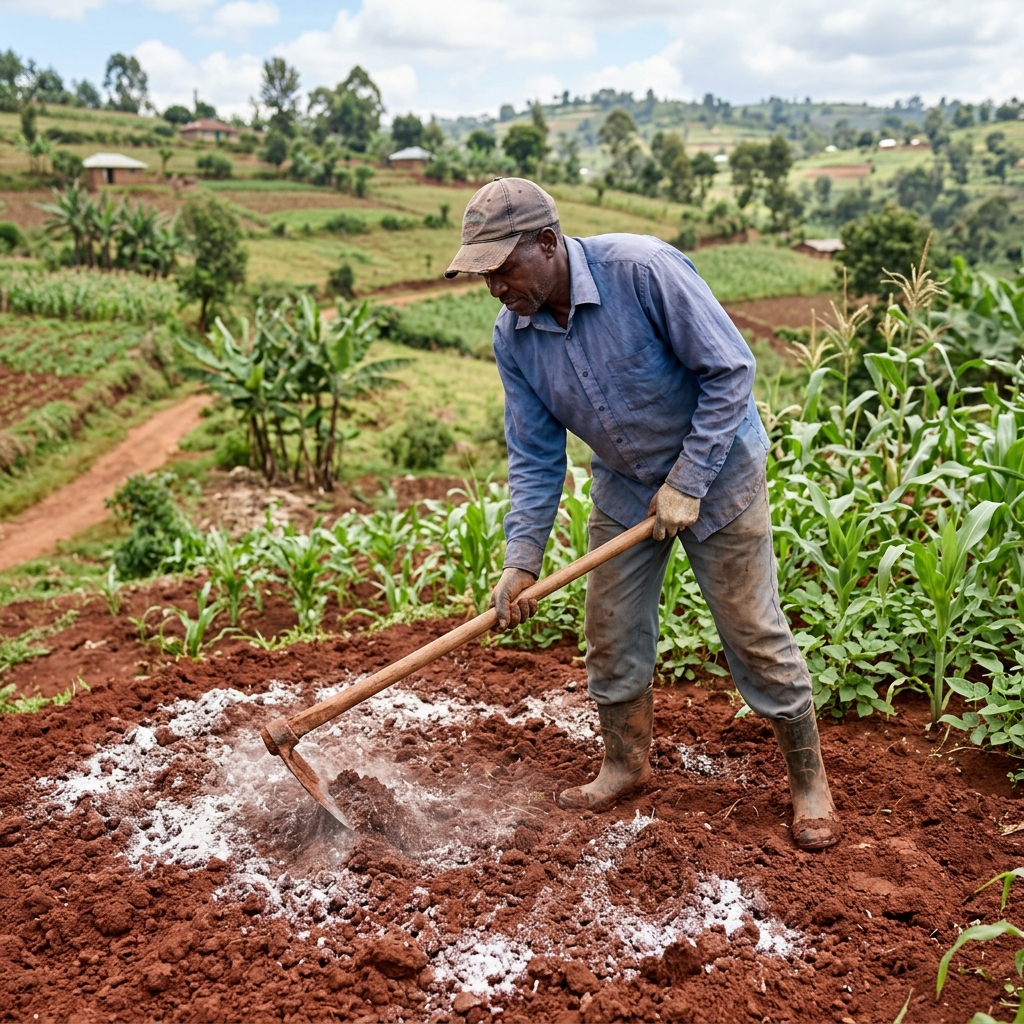
Cause 1: volcanic parent material
Kenya's highland agricultural counties — Kiambu, Murang'a, Nyeri, Meru, Kirinyaga, Embu, and the Aberdare footzones — sit on volcanic rocks from Mount Kenya and the Aberdare Range. These volcanic deposits weather over thousands of years to produce kandic clay minerals rich in iron and aluminium oxides. These minerals are inherently acidic — they create a naturally low pH baseline that predates any farming activity.
The practical implication: even virgin forest soils in these counties typically have pH 5.0 to 5.5. The moment farming begins and the other two acidification processes start, pH drops below the 5.5 threshold where aluminium toxicity begins damaging crop roots. Counties like Kakamega, Bungoma, and Kisii in Western Kenya have similar geology from different volcanic periods with the same acidifying result.
Cause 2: rainfall leaching of alkaline cations
Kenya's highland and western counties receive 900 to 1,800 mm of annual rainfall. This water percolates through the soil profile, dissolving and carrying calcium (Ca2+), magnesium (Mg2+), and potassium (K+) — the alkaline cations that buffer soil against acidity — downward into the subsoil and groundwater. The longer a soil has been under high rainfall without replacement of these cations, the more acidic it becomes.
| County | Annual rainfall (mm) | Typical pH range | Leaching severity |
|---|---|---|---|
| Kakamega | 1,500–1,900 | 4.8–5.5 | Severe |
| Kiambu | 900–1,200 | 5.2–6.0 | Moderate–High |
| Meru (upper) | 1,200–1,600 | 4.5–5.5 | Severe |
| Nyeri | 800–1,400 | 4.8–5.8 | High |
| Nakuru | 800–1,000 | 5.8–6.8 | Low–Moderate |
| Kajiado | 400–700 | 7.5–8.5 | None — alkaline |
Cause 3: nitrogen fertilizer acidification
Every kilogram of ammonium-based nitrogen fertilizer — CAN, urea, ammonium sulfate, DAP — adds to soil acidity through the nitrification process. Soil bacteria convert ammonium (NH4+) to nitrate (NO3−), releasing two hydrogen ions per molecule. At 50 kg of CAN per acre per season, soil pH drops by 0.1 to 0.2 units per season.
The cumulative effect most farmers miss
A farmer applying CAN at 50 kg per acre for 10 seasons without any lime application has lowered soil pH by 1.0 to 2.0 units. A farm that started at pH 6.0 in 2010 may now be at pH 4.5 to 5.0 — deep in the aluminium toxicity zone. The farmer sees declining yields year after year, applies more fertilizer in response, and accelerates the acidification that is causing the decline. Without pH measurement, this spiral is invisible.
| Fertilizer | N content | Acidification rate | pH drop per 10 seasons | Alternative |
|---|---|---|---|---|
| Urea | 46% N | High | 1.5–2.5 units | CAN (less acidifying per unit N) |
| CAN | 26% N | Moderate | 1.0–2.0 units | Lime maintenance offsets |
| Ammonium sulfate | 21% N | Very High | 2.0–3.0 units | Use only on alkaline soils |
| DAP | 18% N, 46% P | Moderate | 0.8–1.5 units | Lime 3 weeks before DAP |
Soil pH across Kenya's agricultural counties
ShambaIQ's precision soil mapping reveals that Kenya's soil acidity follows a clear geographic pattern driven by the three causes above: high-rainfall volcanic counties are most acidic, low-rainfall rift valley counties are neutral to alkaline, and semi-arid counties are alkaline.
Strongly Acidic (pH < 5.5)
Kakamega, Bungoma, Vihiga, Meru upper, Nyeri upper, Kisii, Nyamira, Embu, Tharaka Nithi
Lime required — 1 to 2.5 t/acre
Moderately Acidic (pH 5.5–6.0)
Kiambu, Murang'a, Kirinyaga, Nandi, Bomet, Kericho, Trans Nzoia
Maintenance lime — 0.5 to 1 t/acre
Neutral to Alkaline (pH > 6.0)
Nakuru, Uasin Gishu, Laikipia, Kajiado, Narok, Baringo, Machakos
No lime needed — some require acidifying inputs
Recognising acidity in the field — without a soil test
Maize stunted and pale despite CAN application
The classic aluminium toxicity presentation. Roots are damaged before they can absorb the nitrogen you just applied. CAN goes into the soil and volatilises without uptake. More CAN does not help — only liming reverses this.
Short, stubby root systems with brown tips
Pull a stunted maize plant. If the roots are short, thickened, and have dark brown tips rather than white growing tips, aluminium is binding to the root meristem and blocking cell division. This is the definitive field diagnosis of aluminium toxicity.
Beans fail to nodulate — no pink bumps on roots
Rhizobium bacteria are sensitive to pH below 5.5. If you inoculated bean seed with Rhizobium and see no root nodules at 6 weeks, soil pH is likely too low for the bacteria to survive. Lime is the precondition — inoculant only works above pH 5.5.
Successive seasons of declining yields on the same field
Progressive yield decline despite consistent fertilizer application is the signature of cumulative acidification from nitrogen fertilizers without lime maintenance. Each season the pH drops slightly further, each season the fertilizer works slightly less, each season the farmer blames the seed or the rain.
The lime treatment programme
| Starting pH | Lime rate (t/acre) | Cost at KES 700/bag | Apply before planting | Target pH |
|---|---|---|---|---|
| Below 4.5 | 2.5 tonnes (50 bags) | KES 35,000 | 6+ weeks | 5.8–6.2 |
| 4.5–5.0 | 2.0 tonnes (40 bags) | KES 28,000 | 6 weeks | 6.0–6.2 |
| 5.0–5.5 | 1.5 tonnes (30 bags) | KES 21,000 | 4 weeks | 6.0–6.5 |
| 5.5–6.0 | 0.75 tonnes (15 bags) | KES 10,500 | 3 weeks | 6.2–6.5 |
| Annual maintenance | 0.3–0.5 tonnes | KES 4,200–7,000 | After harvest | Maintain > 6.0 |
Step-by-step: testing and correcting acidic soil
- 1
Get your exact farm pH from ShambaIQ
Visit shambaiq.com and enter your county and crop. ShambaIQ returns your farm's predicted pH from precision soil mapping at 30-metre resolution. Lime rate varies enormously — a farm at pH 4.5 needs 2.5 times more lime than one at pH 5.5. Know your starting pH before spending on inputs.
- 2
Calculate lime requirement from pH reading
Below pH 4.5: 2.5 tonnes dolomitic lime per acre. pH 4.5 to 5.0: 2 tonnes. pH 5.0 to 5.5: 1 to 1.5 tonnes. pH 5.5 to 6.0: 500 kg to 1 tonne for maintenance. Target pH 6.0 to 6.5 for maize, beans, and vegetables.
- 3
Apply lime 4 to 6 weeks before planting
Broadcast lime evenly and incorporate to 15 cm depth by ploughing or hoeing. Lime left on the surface reacts very slowly. On sloping land, apply on still days to prevent uneven distribution from wind.
- 4
Wait 3 weeks before applying DAP
Calcium from lime reacts with phosphate from DAP to form insoluble calcium phosphate, locking out the phosphorus entirely. The 3-week separation is mandatory, not optional.
- 5
Apply maintenance lime annually after harvest
Once target pH is reached, apply 300 to 500 kg per acre annually to offset the acidifying effect of nitrogen fertilizers. Without maintenance liming, soils under continuous cropping reacidify at 0.1 to 0.2 pH units per year.
Free Precision Tool
Check if your county soil needs lime — get the exact dosage and cost breakdown.
ShambaIQ tells you your exact soil pH and calculates your lime requirement before you spend anything. Free. No sign-up required.
Check My Soil pH