Sweet potato farming in Homa Bay: The complete Lake Victoria shore guide
Homa Bay’s sandy-loam soils along the Lake Victoria shore are uniquely suited to sweet potato production — but most farmers here are halving their yields with one avoidable mistake: treating sweet potatoes like maize with nitrogen-heavy fertilizers. This guide fixes that, with soil data, certified variety rankings, and a full KES-costed plan per acre.
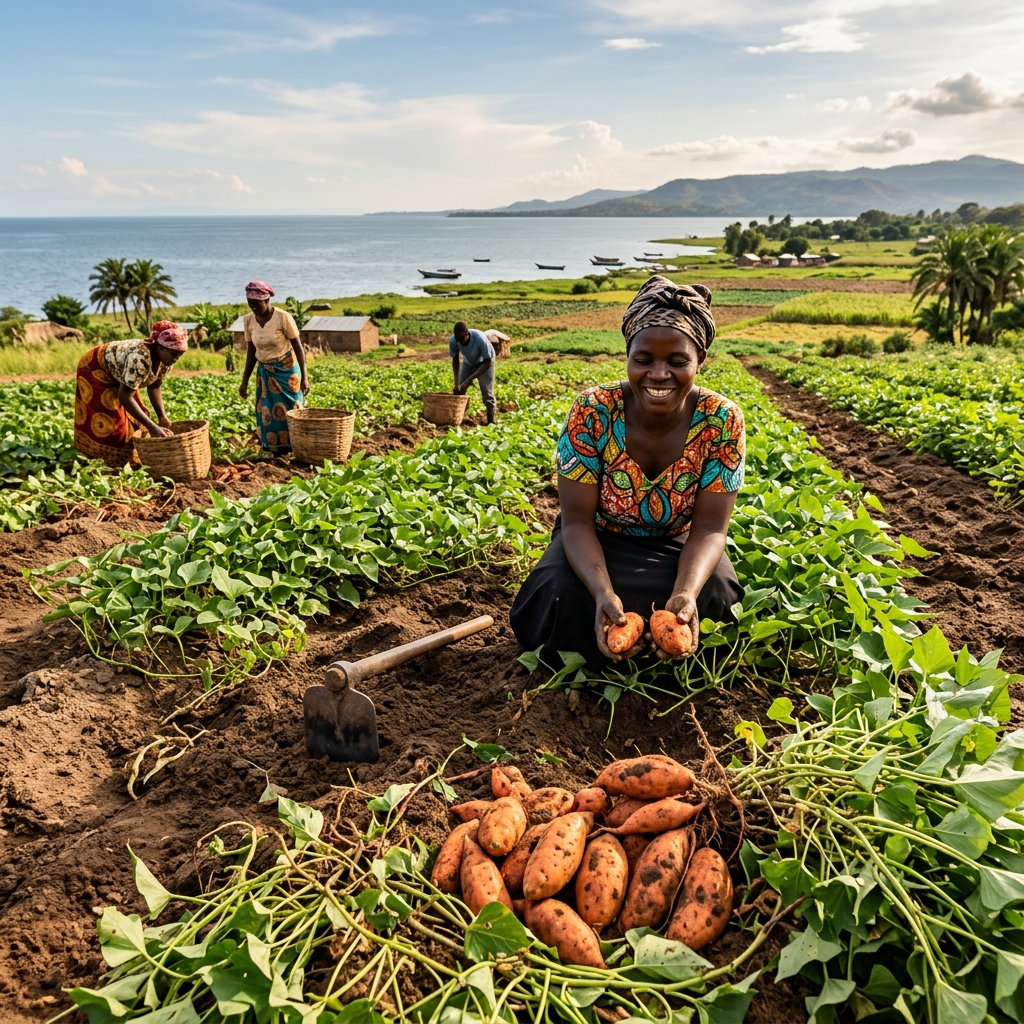
Why Homa Bay is one of Kenya’s best sweet potato counties
Kenya produces over 900,000 tonnes of sweet potatoes annually, making it the third-largest crop by volume after maize and beans. But production is unevenly distributed — and Homa Bay, despite ideal soil conditions, is consistently under-performing relative to its potential.
Three structural advantages make Homa Bay exceptional for sweet potato production:
- Sandy-loam texture
The Lake Victoria shoreline soils are naturally loose and well-drained — exactly the tilth sweet potato tubers need to expand without deformation or rotting. Unlike the heavy black cotton soils of the Mwea or the clay loams of the Central Highlands, Homa Bay soils offer minimal resistance to tuber bulking.
- Bimodal rainfall
Homa Bay receives two reliable rain seasons (March–May and September–November) with average annual rainfall of 900–1,200 mm. This allows two sweet potato crops per year, compared to one in semi-arid counties like Kajiado or Machakos.
- Established market access
Proximity to Kisumu City (Kenya's third-largest urban market), cross-border trade to Uganda and Tanzania, and growing demand for orange-fleshed varieties from NGO nutrition programmes all create premium buyers within reach.
Homa Bay soil data — what ShambaIQ precision data satellite mapping shows
ShambaIQ pulls soil nutrient data from its Geo-Spectral satellite model — county-average measurements calibrated against 130,000+ regional soil samples. Here is what the data shows for Homa Bay County:
| Nutrient | Homa Bay value | Sweet potato optimum | Status |
|---|---|---|---|
| Soil pH | 5.6 – 6.2 | 5.5 – 6.5 | ✅ Optimal |
| Total Nitrogen (g/kg) | 1.2 – 1.8 | Low N preferred | ✅ Good (no excess) |
| Extractable Phosphorus (mg/kg) | 8 – 18 | > 10 mg/kg | ⚠️ Marginal |
| Extractable Potassium (mg/kg) | 60 – 110 | > 150 mg/kg | ❌ Deficient — supplement |
| Organic Carbon (g/kg) | 8 – 15 | > 10 g/kg | ✅ Adequate |
Source: high-resolution satellite prediction, 0–20 cm depth, Homa Bay County average. Individual farm values may vary. Get your exact farm data →
The critical insight: potassium is the limiting nutrient in Homa Bay for sweet potato production. Soil potassium averages 60–110 mg/kg — well below the 150 mg/kg optimum. This is the single most important soil chemistry fact for any Homa Bay sweet potato farmer, and it directly dictates fertilizer choice.
The nitrogen mistake that’s halving yields across Homa Bay
Walk through any sweet potato farm in Nyanza and you’ll see the same pattern: lush, dark-green, sprawling vines— and disappointingly small tubers at harvest. Farmers assume the crop is doing well because the foliage looks healthy. It isn’t. It’s burning nitrogen on leaves instead of building tubers.
The Science in Plain Language
Sweet potatoes are tuber crops. Their productivity is measured underground, not above it. Nitrogen (N) is the growth driver for shoots, leaves, and stems — the vegetative parts of the plant. Potassium (K) is the yield driver for storage organs — roots and tubers. When N is high and K is low, the plant directs all photoassimilates (sugars produced by photosynthesis) to vegetative growth instead of tuber storage. You get a beautiful canopy and a terrible harvest.
The root cause is a reasonable but wrong analogy: maize follows a fertilize-with-CAN logic that is deeply embedded in Kenyan farming culture. Farmers who have grown maize for generations transfer that fertilizer behaviour to sweet potatoes — and it backfires entirely. Unlike maize in Homa Bay which responds well to nitrogen top-dressing, sweet potatoes need the opposite: high potassium, minimal nitrogen, no CAN after planting.
Fertilizer guide: what to use, when, and how much
| Fertilizer | N-P-K | Use for sweet potato? | Why |
|---|---|---|---|
| Mavuno Sweet Potato | 4-14-27 | ✅ Best choice | High K exactly matches Homa Bay deficiency |
| NPK 17:17:17 | 17-17-17 | ⚠️ Acceptable | Balanced but K still lower than ideal |
| DAP (18:46:0) | 18-46-0 | ❌ Avoid | Zero potassium — useless for tubers |
| CAN (26% N) | 26-0-0 | ❌ Never use | Pure nitrogen — causes vine excess, kills yield |
| Urea (46% N) | 46-0-0 | ❌ Never use | Same as CAN, worse effect on tubers |
| Organic compost | Variable | ✅ Excellent base | Improves K availability and soil structure |
Application schedule
Apply Mavuno Sweet Potato at 50 kg/acre into the ridge. Incorporate organic compost at 2 tonnes/acre if available.
Check vine establishment. Rogue out any diseased or virus-infected plants. Do NOT apply any fertilizer.
Final weeding. Vines should be covering ridges. Still no additional fertilizer needed. The Mavuno basal is sufficient for the full season.
Harvest when vines yellow and die back. Early-morning harvest reduces field heat damage in Homa Bay's lowland climate.
Best certified sweet potato varieties for Western Kenya
Only plant KEPHIS-certified material. Uncertified vines carry Sweet Potato Feathery Mottle Virus (SPFMV) and Sweet Potato Chlorotic Stunt Virus (SPCSV) — together causing Sweetpotato Virus Disease (SPVD) which destroys up to 90% of yield and for which there is no cure. Certified vines are virus-tested. This is non-negotiable.
Kabode
High beta-carotene. Drought-tolerant. Best for nutrition programmes.
SPK004 (Vita)
Sweetest flavour. Preferred for fresh Kisumu market.
Kakamega farmer choice
Adapted to Western Kenya humidity. Good storability.
White Star
High dry matter. Chips and crisps market. Lower beta-carotene.
Planting calendar for Homa Bay
| Season | Plant | Weed / establish | Harvest | Notes |
|---|---|---|---|---|
| Long Rains | March – April | April – May | June – July | Main season. Highest yields. |
| Short Rains | October – November | November – December | January – February | Good season. Lower rainfall risk. |
Maize–sweet potato rotation: the smartest sequence for Homa Bay
Continuous maize on Homa Bay soils progressively depletes nitrogen and organic carbon while allowing striga (Striga hermonthica) weed buildup — the single biggest yield thief in Western Kenya maize. Sweet potatoes break this cycle completely: they are not a striga host, their vine canopy suppresses weeds, and their vine residues add organic matter back to the soil.
ShambaIQ Recommended 3-Season Rotation for Homa Bay
Season 1
Maize + Beans
Long rains. DAP + CAN.
Season 2
Sweet Potato
Short rains. Mavuno Sweet Potato only.
Season 3
Beans / Cowpeas
Long rains. Rhizobium inoculant. No fertilizer.
This rotation improves soil organic matter progressively across all three seasons, reduces external fertilizer inputs by ~30% by Year 2, and eliminates striga. See the full rotation analysis for Homa Bay at Homa Bay County Soil Report.
Step-by-step: how to grow sweet potatoes in Homa Bay
- 1
Test your soil and get a nutrient baseline
Run your Homa Bay location through the ShambaIQ tool at shambaiq.com/app. This gives you a county-average soil baseline (pH, potassium, nitrogen, and phosphorus) so you know your starting fertilizer needs. For field-level precision, use the GPS pin mode.
- 2
Prepare land: plough deep and build ridges
Sweet potato tubers need loose, aerated soil to expand. Plough to 30 cm depth. Form ridges 1 m apart and 30 cm high for good drainage and tuber room. On Homa Bay's sandy soils, ridges also reduce soil erosion during Lake Victoria rainfall events.
- 3
Apply basal fertilizer at planting
Apply Mavuno Sweet Potato at 50 kg per acre into the ridge at planting. Do NOT use DAP (too high in nitrogen and phosphorus relative to potassium). Do NOT use CAN or Urea at this stage. If your ShambaIQ result shows pH below 5.5, incorporate 300–500 kg agricultural lime per acre 2 weeks before planting.
- 4
Plant certified vine cuttings
Plant certified KEPHIS vine cuttings (15–20 cm) at 30 cm spacing on ridges. Bury at least 2 nodes. Plant at the onset of rains — March/April for long rains, October for short rains. Avoid planting during dry spells as vine establishment fails without moisture in sandy soils.
- 5
Weed at 2 and 6 weeks — then let vines cover
Weed thoroughly at 2 and 6 weeks after planting. After 6 weeks the vine canopy suppresses weeds naturally — do not disturb ridges after this point or you risk breaking developing tubers from the root system.
- 6
No nitrogen top-dressing
Do not apply CAN, Urea, or any nitrogen-rich top-dresser after planting. This is the single most common mistake in Homa Bay sweet potato production. Nitrogen pushes vine and leaf growth at the direct expense of tuber bulking. Your Mavuno basal fertilizer provides sufficient nutrients for the full season.
- 7
Harvest at 3–4 months
Harvest when vines begin yellowing and dying back (90–120 days). Check tuber size by gently digging one ridge first. Delay harvest past 120 days risks cracking and increased starch-to-sugar conversion which reduces market value. Target early-morning harvest to reduce field heat damage on the Lake Victoria lowlands.
Budget: total KES cost per acre in Homa Bay
| Item | Qty | Unit cost (KES) | Total (KES) |
|---|---|---|---|
| Certified vines (bundles) | 50 | 50 | 2,500 |
| Mavuno Sweet Potato (50 kg) | 1 bag | 3,200 | 3,200 |
| Agricultural lime (50 kg) | 2 bags* | 600 | 1,200 |
| Labour — land prep & planting | 4 days | 500 | 2,000 |
| Labour — weeding (×2) | 4 days | 500 | 2,000 |
| Labour — harvest | 3 days | 500 | 1,500 |
| TOTAL INPUT COST | ~KES 12,400 | ||
| Expected revenue (10 t/acre @ KES 20/kg) | KES 200,000 | ||
* Lime only required if ShambaIQ shows pH below 5.5 for your specific farm. Prices are indicative 2026 market rates. Use Homa Bay agrovets for current pricing.
Free Precision Tool
Plan Your Crop Rotation: Sweet potatoes are the perfect maize rotation crop. Calculate the optimal fertilizer schedule at ShambaIQ Homa Bay Sweet Potato Tool.
ShambaIQ pulls your farm’s exact soil data from precision satellite soil mapping and calculates the precise bags, application timing, and KES cost per acre — personalised to your county and crop. Free. No sign-up required.
Open ShambaIQ Advisory Tool →