High-yield onion farming in Kajiado:A drylands goldmine
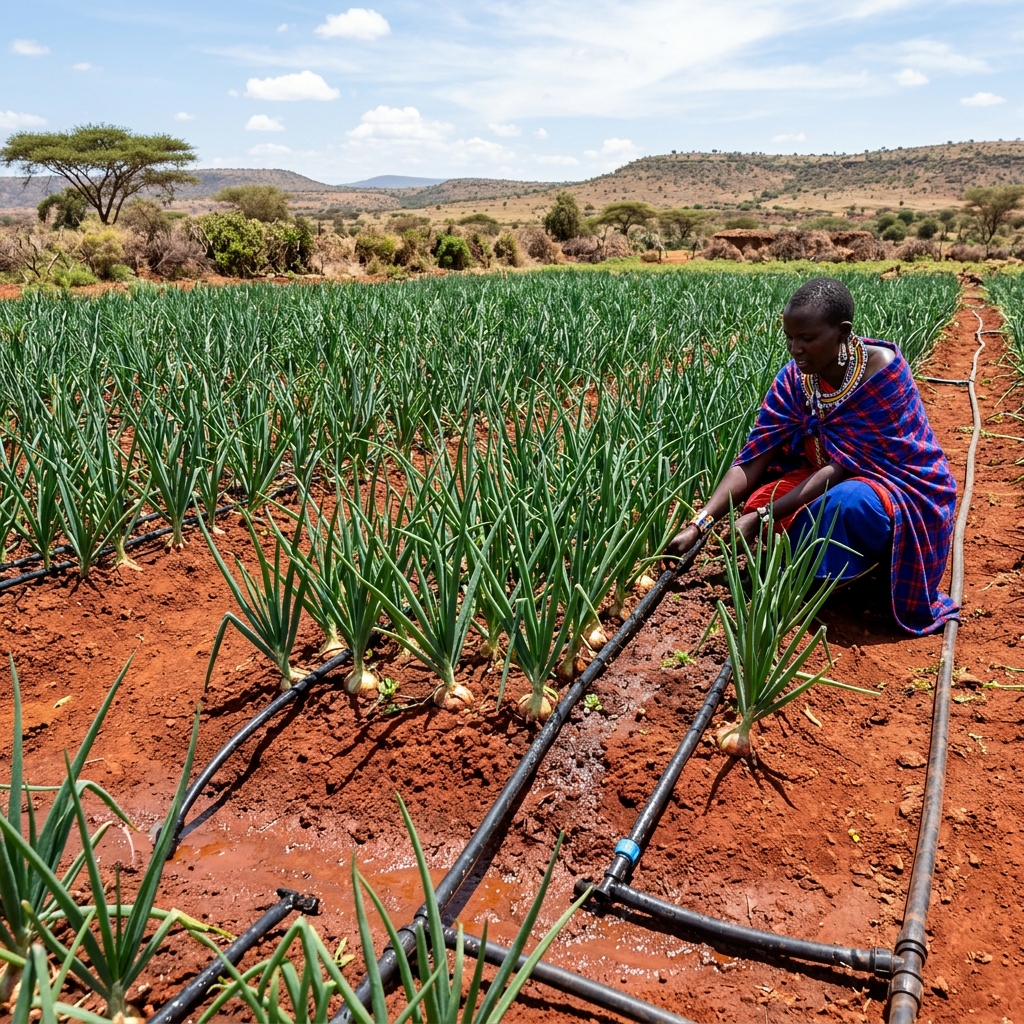
Kajiado County's semi-arid conditions, alkaline soils, and water scarcity make it one of the more challenging farming environments in Kenya. Yet onions — when managed with precision — consistently outperform almost every other crop in this landscape. The dry conditions that stress other crops are exactly what onions need for bulb formation and post-harvest curing. The challenge is not the climate. It is the soil chemistry: Kajiado's naturally alkaline soils lock out zinc and iron, and standard fertilizer programmes designed for acidic highland soils make the alkalinity worse rather than better.
Why Kajiado is an onion goldmine
Kenya imports significant volumes of onions from Tanzania, Ethiopia, and Egypt to meet demand — yet Kajiado, sitting on Nairobi's doorstep with ideal onion-growing climate, remains underutilised for onion production. Three structural advantages make the case compelling.
Onions require dry conditions during the final third of their growing season for proper bulb maturation. Kajiado's low humidity and high temperatures during the dry season accelerate the natural curing process that concentrates sugars and firms the outer skins — producing bulbs with 3 to 4 month shelf life compared to 4 to 6 weeks for onions grown in humid highland counties.
Unlike rain-dependent highland counties limited to two planting windows, Kajiado's irrigation-based farming allows planting in any month. Farmers who stagger plantings can achieve three onion crops per year and time harvests to the highest-price windows — particularly December to February when national onion supply tightens.
Kajiado County borders Nairobi and Machakos, with tarmac road access to Wakulima Market within two hours. This proximity eliminates the post-harvest losses from long transport that reduce margins for onion farmers in more distant counties. It also allows Kajiado farmers to sell directly to Nairobi hotels, supermarkets, and restaurants that pay premium prices for consistent supply.
Alkaline soils — the core challenge
Most Kenyan farming advice is written for highland acidic soils — the soils of Kiambu, Nyeri, Kakamega, and the Central Highlands where the majority of smallholder farmers operate. This advice is actively harmful when applied to Kajiado's alkaline soils, because the fertilizers and lime recommendations designed for acidic soils push Kajiado's pH even higher.
The Standard Advice That Damages Kajiado Soils
DAP is the default basal fertilizer across Kenya. In acidic highland soils it is appropriate. In Kajiado's soils at pH 7.5 to 8.5, DAP raises pH further because its diammonium component hydrolyses to release hydroxide ions. Every bag of DAP applied to alkaline Kajiado soil makes the zinc and iron lockout worse. The correct substitution is NPK 17:17:17 at planting and ammonium sulfate for all top-dressings — both of which have mild acidifying effects that work with Kajiado's soil chemistry rather than against it.
Kajiado soil data for onions
ShambaIQ's precision soil mapping reveals a consistent profile across Kajiado's onion-growing sub-counties of Kajiado Central, Isinya, and Ngong:
| Nutrient | Kajiado average | Onion optimum | Status | Action |
|---|---|---|---|---|
| Soil pH | 7.5 – 8.5 | 6.0 – 7.0 | Alkaline — Critical | Elemental sulfur + ammonium sulfate |
| Total Nitrogen (g/kg) | 0.8 – 1.4 | > 1.2 g/kg | Low | Ammonium sulfate top-dressings |
| Phosphorus (mg/kg) | 8 – 20 | > 15 mg/kg | Marginal | NPK 17:17:17 at planting |
| Potassium (mg/kg) | 180 – 380 | > 150 mg/kg | Adequate | No K supplement needed |
| Zinc (mg/kg) | 0.3 – 0.8 | > 1.0 mg/kg | Deficient | Zinc sulfate foliar essential |
| Organic Carbon (g/kg) | 5 – 12 | > 10 g/kg | Low | Incorporate crop residues and compost |
Source: ShambaIQ precision soil mapping, 0 to 20 cm depth, Kajiado County average. Get your farm-specific pH and zinc reading here.
Zinc and iron deficiency — diagnosis and fix
At pH above 7.5, zinc and iron form insoluble hydroxide compounds that plant roots cannot absorb regardless of total soil content. The symptoms are distinctive and allow field diagnosis without a soil test.
Zinc deficiency
Iron deficiency
Best onion varieties for Kajiado county
Only short-day varieties bulb reliably at Kajiado's near-equatorial latitude of 1.5 to 2.5 degrees south. Long-day varieties bred for temperate climates will produce abundant leaf growth but fail to form bulbs at all.
Jere F1
Short-day hybrid
Most popular in Kajiado. Heat tolerant, large uniform bulbs, excellent shelf life. Preferred by Nairobi wholesale buyers.
Red Bombay
Short-day OPV
Lower seed cost. Good flavour preferred for retail market. Smaller bulb size means lower per-tonne price at wholesale.
Jambar F1
Short-day hybrid
Good fusarium basal rot resistance. Useful on farms with previous disease history. Slightly less heat tolerant than Jere.
Ammonium sulfate fertilizer programme for Kajiado onions
The fertilizer programme for Kajiado onions is built around the principle of acidifying nutrition — every input chosen not just for its NPK content but for its effect on soil pH. This distinguishes Kajiado management from standard Kenyan onion programmes.
| Stage | Product | Rate/acre | Timing | pH effect |
|---|---|---|---|---|
| Pre-plant (if pH > 8.0) | Elemental sulfur | 300 kg | 6 weeks before planting | Lowers pH 0.5 – 1.0 units |
| At transplanting | NPK 17:17:17 | 50 kg | In transplant furrow | Neutral to slight acidification |
| Top-dress 1 | Ammonium sulfate | 50 kg | 3 weeks after transplant | Mild acidification per application |
| Top-dress 2 | Ammonium sulfate | 50 kg | 6 weeks after transplant | Cumulative acidification |
| Foliar 1 | Zinc sulfate (2 g/L) | Per spray | 3 weeks after transplant | Bypasses pH lockout |
| Foliar 2 | Zinc sulfate (2 g/L) | Per spray | 6 weeks after transplant | Maintains zinc supply |
Drip irrigation in Kajiado's semi-arid conditions
Drip irrigation is not optional for commercial onion production in Kajiado — it is the technology that makes the system viable. The semi-arid climate provides the dry curing conditions that produce premium onions, but those same conditions require precise water management to maintain bulb development without moisture stress.
Establishment (weeks 1–3)
Newly transplanted seedlings have minimal root systems and cannot tolerate any soil moisture deficit. Maintain consistently moist but not waterlogged conditions. Avoid surface drying between irrigations during this phase.
Vegetative growth (weeks 3–7)
Leaf development and root expansion phase. Consistent moisture supports rapid leaf growth that determines the photosynthetic capacity available for bulb fill. Moisture stress at this stage permanently reduces final bulb size.
Bulb formation (weeks 7–14)
Peak water demand. Bulb cells are dividing and expanding rapidly. This is the highest-return irrigation period — water stress during bulb formation reduces yield by 20 to 40 percent. Maintain strict moisture targets.
Maturation (weeks 14–16)
Begin reducing irrigation as tops start yellowing. Dry-down concentrates sugars, firms outer skins, and initiates the curing process. Do not irrigate in the final week before harvest — wet soils produce poorly-cured bulbs that rot in storage.
Step-by-step: growing onions in Kajiado county
- 1
Check soil pH and zinc status before planting
Use ShambaIQ at shambaiq.com/app to get your farm's exact pH reading. Kajiado soils commonly show pH 7.5 to 8.5 — above 8.0 requires elemental sulfur incorporated 6 weeks before planting. Zinc deficiency is endemic at these pH levels and must be addressed proactively.
- 2
Incorporate elemental sulfur if pH is above 8.0
Broadcast elemental sulfur at 300 to 400 kg per acre and incorporate to 15 cm depth at least 6 weeks before planting. Soil bacteria oxidise elemental sulfur to sulfuric acid over this period, lowering pH by 0.5 to 1.0 units. This is the most cost-effective soil acidification method available to Kajiado smallholders.
- 3
Install drip irrigation before planting
Install drip tape at 30 cm spacing along the bed surface. Connect to a water source with a simple timer or manual schedule. Drip irrigation is non-negotiable for Kajiado onions — flood irrigation causes the wet-dry cycles that trigger bolting and split bulbs, and wastes scarce water in semi-arid conditions.
- 4
Transplant seedlings with NPK 17:17:17 at planting
Transplant 35-day-old onion seedlings at 15 cm within rows and 30 cm between rows, giving approximately 88,000 plants per acre. Apply NPK 17:17:17 at 50 kg per acre in a band along the transplanting furrow. Water immediately after transplanting. Transplant in the late afternoon to reduce heat stress on newly set plants.
- 5
Apply ammonium sulfate top-dressing at 3 weeks
Apply ammonium sulfate at 50 kg per acre in a ring 5 cm from the stem at three weeks after transplanting. Ammonium sulfate provides nitrogen while its sulfate component gradually acidifies the root zone — addressing the alkalinity problem with every feeding. Do not substitute urea or CAN which raise pH further.
- 6
Spray zinc sulfate foliar at 3 and 6 weeks
Spray zinc sulfate at 2 g per litre across the entire canopy at three and six weeks after planting. Zinc deficiency in alkaline soils causes stunted growth and tip yellowing that cannot be corrected through soil application alone — foliar delivery bypasses the soil chemistry that blocks zinc uptake at high pH.
- 7
Apply second ammonium sulfate at 6 weeks and stop nitrogen
Apply a second ammonium sulfate top-dressing at 50 kg per acre at six weeks. Stop all nitrogen applications after this point — late nitrogen delays bulb maturation, produces necky, poorly-cured bulbs that rot in storage, and dramatically reduces shelf life at Nairobi wholesale markets.
- 8
Harvest at 75 percent top fall and cure before selling
Harvest when 75 percent of tops have fallen naturally. Pull bulbs and leave them on the soil surface for 7 to 10 days for field curing, then move to a shaded, well-ventilated store for 2 weeks before selling. Properly cured Kajiado onions store for 3 to 4 months — a significant market timing advantage over fresh vegetables.
Cost and revenue budget per acre — Kajiado onion 2026
| Item | Qty | Unit cost (KES) | Total (KES) |
|---|---|---|---|
| Certified Jere F1 seed | 500 g | 8,000 | 8,000 |
| Elemental sulfur (if pH > 8.0) | 300 kg | 2,500 | 7,500 |
| NPK 17:17:17 (50 kg bag) | 1 bag | 4,200 | 4,200 |
| Ammonium sulfate (50 kg bag x2) | 2 bags | 2,800 | 5,600 |
| Zinc sulfate foliar (2 applications) | 2 | 600 | 1,200 |
| Fungicide (purple blotch prevention) | 3 applications | 900 | 2,700 |
| Insecticide (thrips control) | 3 applications | 800 | 2,400 |
| Drip irrigation tape (amortised Year 1) | per acre | 12,000 | 12,000 |
| Water cost (borehole/pan) | per season | 8,000 | 8,000 |
| Labour — nursery and transplanting | 5 days | 500 | 2,500 |
| Labour — weeding and spraying | 6 days | 500 | 3,000 |
| Labour — harvest and curing | 4 days | 500 | 2,000 |
| TOTAL INPUT COST (Year 1) | KES 59,100 | ||
| Expected revenue (18 t x KES 22/kg) | KES 396,000 | ||
| Net margin Year 1 | KES 336,900 | ||
Drip tape amortises over 3 seasons — Year 2 cost drops by KES 12,000. Elemental sulfur only required on soils above pH 8.0. Find Kajiado agrovets and current input prices here.
Free Precision Tool
Optimize Dryland Irrigation: Pre-fill your water and soil properties at ShambaIQ Kajiado Onion Advisor.
ShambaIQ checks your Kajiado farm's exact soil pH and zinc status and calculates whether you need elemental sulfur, the right fertilizer programme, and your irrigation schedule for the season. Free. No sign-up required.
Open Kajiado Onion Advisor