Acidic soil treatment:Restoring crop vitality in Meru and Nyeri
The volcanic highland soils of Meru and Nyeri counties are among the most naturally fertile in Kenya by total nutrient content. Yet large portions of both counties produce consistently poor yields of maize, beans, and vegetables — not because the nutrients are absent, but because soil pH below 5.0 locks them out entirely. Aluminium and manganese, soluble at low pH, accumulate to levels that poison root tips before they can absorb anything. Liming these soils is not a minor management tweak. It is the difference between farming and not farming productively.
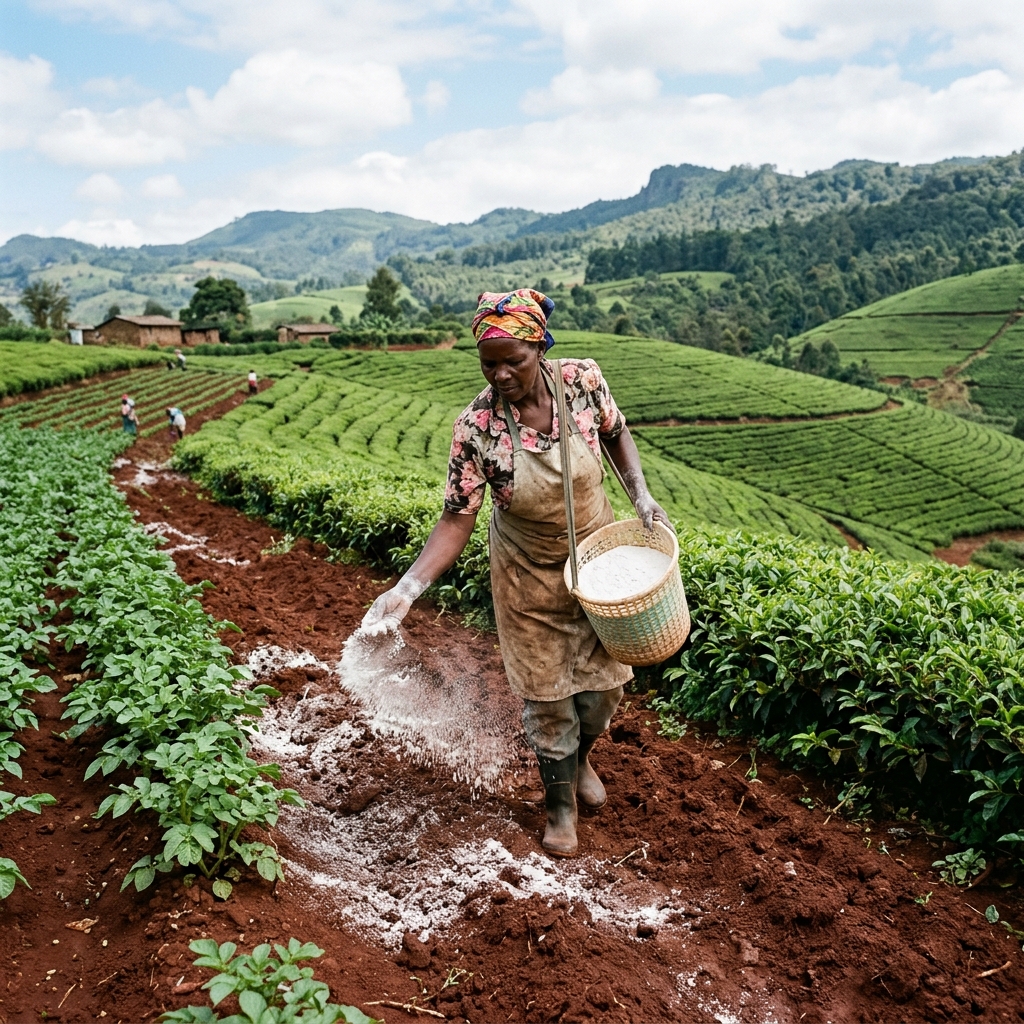
Why Meru and Nyeri soils are so acidic
The acidity of Mount Kenya's highland soils has both geological and agronomic causes — and understanding both is necessary for managing it correctly.
Mount Kenya's lava flows and volcanic ash deposits weather over thousands of years to produce kandic clays — iron and aluminium oxide minerals that are inherently acidic. These minerals dominate the subsoil across Meru's upper slopes and Nyeri's Aberdare footzones, creating a naturally acidic baseline that predates any farming.
Meru and Nyeri receive 900 to 1,400 mm of annual rainfall. This water percolates through the soil profile, carrying calcium, magnesium, and potassium downward into the subsoil and groundwater while leaving hydrogen ions behind. The longer a soil has been under high rainfall, the more leached and acidic it becomes. Meru's highland volcanic soils have been leaching for thousands of years.
Every kilogram of urea or CAN applied adds to soil acidity through the nitrification process — ammonia converts to nitrate, releasing two hydrogen ions per nitrogen molecule. Under continuous intensive cropping with high nitrogen inputs, Meru and Nyeri soils can lose 0.1 to 0.3 pH units per season. Farmers who have been applying urea for 10 to 15 seasons without liming have progressively acidified their soils beyond what the original volcanic parent material would have produced naturally.
Aluminium toxicity — the hidden yield killer
Below pH 5.0, aluminium becomes soluble in soil water and accumulates to concentrations that are directly toxic to plant roots. This aluminium toxicity is the primary mechanism through which strongly acidic Meru and Nyeri soils reduce yields — not nutrient deficiency itself, but physical destruction of the root system that would absorb nutrients.
What Aluminium Does to Plant Roots
Soluble aluminium (Al3+) binds to the growing tips of roots within hours of exposure, blocking cell division and elongation. Root tips thicken, turn brown, and stop growing. The plant compensates by producing more lateral roots, creating a stubby, shallow root system that cannot access deep soil moisture or nutrients. Affected maize plants look yellow and stunted from the earliest growth stages, and no amount of fertilizer applied to the surface soil can be absorbed by roots that cannot grow downward. Liming raises pH above 5.5, where aluminium converts to insoluble aluminium hydroxide and ceases to be toxic.
Soil pH data across Meru and Nyeri
ShambaIQ's precision soil mapping shows significant pH variation within both counties, with the most severe acidity concentrated in the higher-altitude zones closest to Mount Kenya.
| Sub-location | pH range | Aluminium toxicity risk | Lime requirement | Priority |
|---|---|---|---|---|
| Meru — Igembe North/South (upper slopes) | 4.2 – 4.8 | Severe | 2.0 – 2.5 t/acre | Critical |
| Meru — Buuri (Mt Kenya foothills) | 4.5 – 5.2 | High | 1.5 – 2.0 t/acre | High |
| Meru — Imenti (mid-altitude) | 5.0 – 5.6 | Moderate | 1.0 – 1.5 t/acre | Medium |
| Nyeri — Kieni (upper Aberdare) | 4.5 – 5.0 | High | 1.5 – 2.0 t/acre | High |
| Nyeri — Tetu/Othaya (mid-altitude) | 5.0 – 5.8 | Low – Moderate | 0.5 – 1.0 t/acre | Low – Medium |
| Nyeri — Mukurweini (lower slopes) | 5.5 – 6.2 | Low | Maintenance only | Low |
Source: ShambaIQ precision soil mapping averages. Individual farm values may differ significantly. Get your exact farm pH here.
Dolomitic vs calcitic lime — which to use in Meru and Nyeri
Both lime types neutralise soil acidity, but they have different nutrient profiles that matter specifically for Meru and Nyeri's leached volcanic soils.
Dolomitic lime
CaMg(CO3)2
Strongly recommended for Meru and Nyeri
Supplies both calcium and magnesium. Meru and Nyeri's heavily leached volcanic soils are frequently magnesium-deficient — a deficiency that appears as interveinal yellowing on older maize leaves. Dolomitic lime corrects pH, calcium, and magnesium simultaneously. The preferred choice for most Meru and Nyeri farms.
Calcitic lime
CaCO3
Use only if soil magnesium is adequate
Higher calcium content per tonne and slightly faster pH response. However it provides no magnesium — if applied to magnesium-deficient soils it can worsen the Ca:Mg imbalance. Only appropriate if a soil test confirms adequate magnesium. At similar market prices, dolomitic lime provides more value for Meru and Nyeri conditions.
Lime application rates by soil pH
| Current pH | Lime rate (tonnes/acre) | Cost at KES 700/50kg bag | Apply before planting | Target pH |
|---|---|---|---|---|
| Below 4.5 | 2.5 tonnes (50 bags) | KES 35,000 | 6+ weeks before | 5.8 – 6.2 |
| 4.5 – 5.0 | 2.0 tonnes (40 bags) | KES 28,000 | 6 weeks before | 5.8 – 6.2 |
| 5.0 – 5.5 | 1.5 tonnes (30 bags) | KES 21,000 | 4 weeks before | 6.0 – 6.5 |
| 5.5 – 6.0 | 0.75 tonnes (15 bags) | KES 10,500 | 3 weeks before | 6.2 – 6.5 |
| Annual maintenance | 0.25 – 0.5 tonnes | KES 3,500 – 7,000 | After harvest | Maintain above 6.0 |
Phosphorus fixation at low pH — why your DAP is disappearing
At pH below 5.5, iron and aluminium oxides — which dominate Meru and Nyeri's volcanic soils — react aggressively with phosphate ions to form insoluble compounds. A farmer applying one bag of DAP to an unlimed Meru soil at pH 4.8 may be wasting 60 to 80 percent of that phosphorus within days of application. The phosphorus is in the soil — it simply cannot be accessed by roots.
The return on liming exceeds the return on fertilizer on acidic soils
On a Meru farm at pH 4.8, raising pH to 6.2 through liming before planting can double the effectiveness of the DAP already in the soil from previous seasons, in addition to correcting aluminium toxicity and improving nitrogen utilisation. The lime investment pays for itself in the first season through improved fertilizer efficiency alone — before any yield improvement from better root development is counted. The two investments are not comparable — liming unlimes soil, fertilizer feeds it. Soil that cannot absorb fertilizer is soil where fertilizer investment is wasted.
Step-by-step: treating acidic soil in Meru and Nyeri
- 1
Get your exact soil pH before ordering lime
Use ShambaIQ at shambaiq.com/app?county=meru or shambaiq.com/app?county=nyeri to get your farm's exact pH reading from precision soil mapping. Lime rate varies significantly — a farm at pH 4.5 needs 2.5 times more lime than one at pH 5.5. Over-liming beyond pH 6.5 causes manganese and iron deficiency. Know your starting pH before spending on inputs.
- 2
Calculate your lime requirement from the table
At pH below 4.5: apply 2.5 tonnes of dolomitic lime per acre. At pH 4.5 to 5.0: apply 2 tonnes per acre. At pH 5.0 to 5.5: apply 1 to 1.5 tonnes per acre. At pH 5.5 to 6.0: apply 500 kg to 1 tonne per acre for maintenance. These rates target a final pH of 6.0 to 6.5 — optimal for maize, beans, and vegetables.
- 3
Apply lime at least 4 to 6 weeks before planting
Broadcast lime evenly across the entire planting area. On sloping Meru and Nyeri farmland, apply on still days to prevent lime dust from concentrating in low spots. Incorporate immediately by ploughing or hoeing to 15 cm depth. Lime left on the surface without incorporation reacts very slowly and unevenly.
- 4
Do not apply lime and DAP at the same time
Never apply lime and DAP simultaneously. Calcium from lime reacts with phosphate from DAP to form insoluble calcium phosphate — locking out the phosphorus entirely. Apply lime, wait at least 3 weeks, then apply DAP or other phosphorus fertilizer at planting. This sequencing is mandatory.
- 5
Monitor pH response after one season
Check soil pH one season after lime application using ShambaIQ or a soil pH meter. On strongly acidic soils below pH 4.5, a single lime application may only achieve partial correction — a second application the following season may be needed to reach the pH 6.0 target. Liming is a multi-season investment, not a one-off fix.
- 6
Maintain pH with annual maintenance liming
Once target pH is achieved, apply 300 to 500 kg of agricultural lime per acre annually to offset the acidifying effect of nitrogen fertilizers and rainfall leaching. Without maintenance liming, soils under continuous cropping reacidify at approximately 0.1 to 0.2 pH units per year.
Cost of liming per acre in Meru and Nyeri 2026
| Scenario | Lime cost | Expected maize yield (bags/acre) | Revenue at KES 3,500/bag | Net gain from liming |
|---|---|---|---|---|
| Unlimed soil pH 4.8 | KES 0 | 6 – 10 bags | KES 21,000 – 35,000 | Baseline |
| Limed to pH 6.0 (1.5 t) | KES 21,000 | 20 – 28 bags | KES 70,000 – 98,000 | KES 28,000 – 42,000 net |
| Limed to pH 6.0 (2.0 t) | KES 28,000 | 22 – 30 bags | KES 77,000 – 105,000 | KES 21,000 – 42,000 net |
Liming cost amortises over 3 to 4 seasons with annual maintenance top-ups. Find Meru County agrovets and current lime prices here.
Free Precision Tool
Heal Your Soil: Run the ShambaIQ Acidic Soil Checker to calculate your exact lime requirement and cost.
ShambaIQ calculates your exact lime requirement based on your farm's precision soil pH data and shows you the cost breakdown before you spend anything. Free. No sign-up required.
Open Acidic Soil Checker