Complete maize farming guide Kenya 2026:From soil to 30 bags per acre
The average Kenyan smallholder maize farmer harvests 8 to 12 bags per acre. The precision farmer on the same soil in the same county harvests 25 to 35. The difference is not luck, land size, or expensive equipment. It is four decisions made correctly: soil pH before anything, the right variety for the right altitude, fertilizer applied at the right time, and fall armyworm caught early. This guide covers every step from soil to storage with specific recommendations for Kenya's seven major maize-growing agroecological zones.
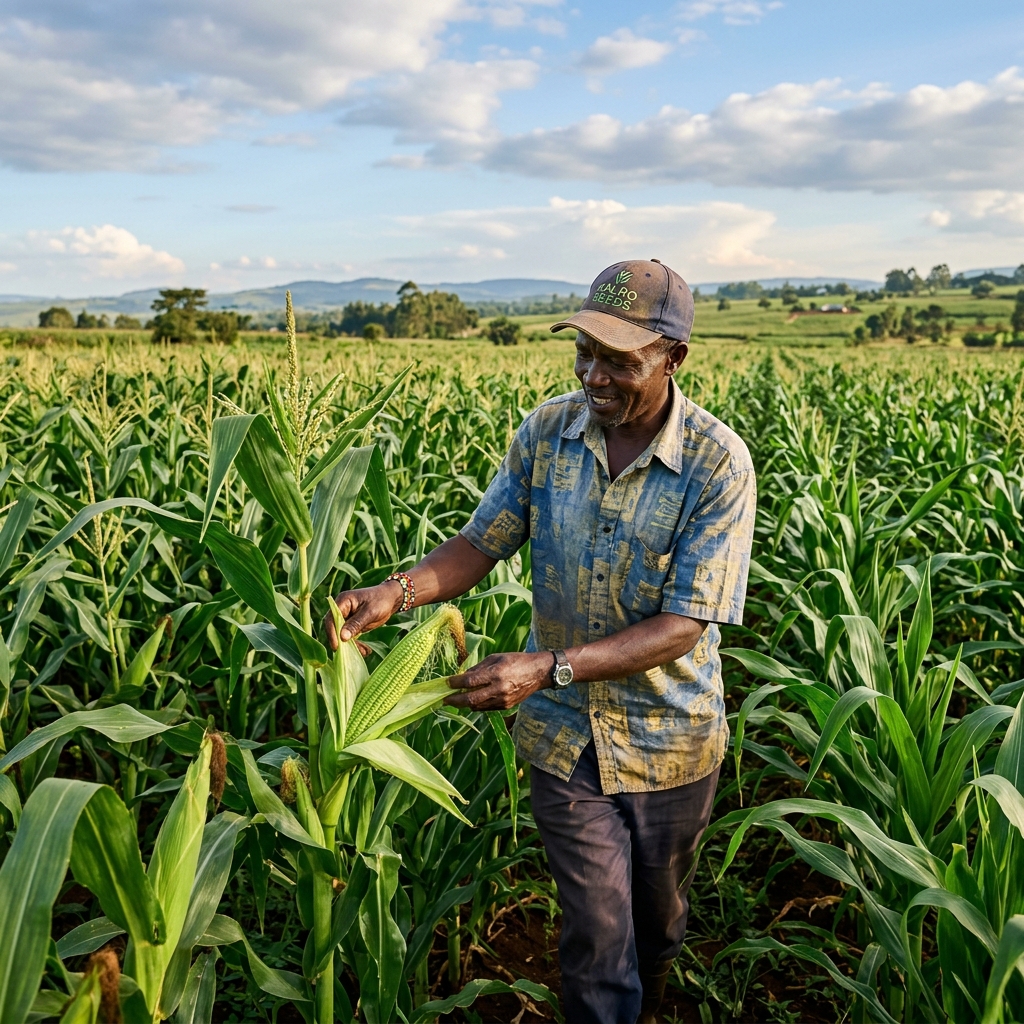
Why most Kenyan maize yields are low
Kenya's national average maize yield of 1.7 tonnes per hectare (roughly 10 bags per acre) is among the lowest in Sub-Saharan Africa for a country with highland potential. Four fixable problems account for most of the gap between current yields and achievable yields.
Wrong soil pH
40–60% yield loss
Most maize in Central and Western Kenya is grown on soils at pH 4.8 to 5.5. Aluminium toxicity at this pH destroys root tips before they can absorb fertilizer. The fertilizer is applied — it goes nowhere.
Wrong variety for the altitude
20–40% yield loss
A highland variety planted in the lowlands fails to silk and set grain properly. A lowland variety in the highlands takes too long to mature. Variety-altitude mismatch is extremely common and almost never discussed by agrovets.
CAN applied at planting instead of knee-height
15–30% efficiency loss
CAN applied at planting volatilises from the soil surface before root uptake. Knee-height CAN is absorbed by an established root system during rapid growth — the same nitrogen does 3× the work.
Fall armyworm left uncontrolled
20–80% yield loss in outbreak years
Fall armyworm is now endemic and reaches economic threshold levels on 60 to 70 percent of Kenyan farms in outbreak seasons. A single spray missed at the early whorl stage can destroy 50 percent of a stand within one week.
Choosing the right maize variety by zone
| Zone | Altitude | Key counties | Top varieties | Days to maturity | Yield potential |
|---|---|---|---|---|---|
| Highland | 1,800–2,400m | Nyandarua, Nyeri upper, Meru upper | H614D, WH507 | 140–160 days | 28–38 bags/acre |
| Upper Midland | 1,500–1,800m | Nakuru, Uasin Gishu, Trans Nzoia | DK8031, H614D, SC403 | 120–140 days | 25–35 bags/acre |
| Midland | 1,200–1,500m | Kakamega, Nandi, Kisii, Embu | DK777, Pioneer 3253, SC403 | 100–120 days | 20–28 bags/acre |
| Lower Midland | 900–1,200m | Machakos, Makueni, Kitui lowlands | WH505, DK8031, DUMA 43 | 90–110 days | 14–22 bags/acre |
| Semi-arid | 600–900m | Kajiado, Baringo lowlands, Kwale | DUMA 43, WH505 | 85–100 days | 10–18 bags/acre |
DAP and CAN fertilizer programme
| Stage | Fertilizer | Rate/acre | Placement | Critical timing |
|---|---|---|---|---|
| At planting | DAP | 50 kg (1 bag) | 5cm below & beside seed in furrow | Same day as planting — never contact seed directly |
| Knee height (4–6 wks) | CAN | 50 kg (1 bag) | Ring 5–10 cm from stem base | Apply before rain — within 24 hrs of forecast |
| Optional: low P soils | TSP or Rock Phosphate | 25–50 kg | Broadcast and incorporate before planting | Soils where P below 10 mg/kg — check ShambaIQ first |
| Optional: acidic soils | Dolomitic lime | 1–2.5 t/acre | Broadcast and incorporate | At least 3 weeks before DAP application |
Fall armyworm and disease control
Fall Armyworm (Spodoptera frugiperda)
Threshold: 10% plant infestationSpray into the whorl, not on leaf surfaces. Scout twice weekly. One spray at threshold is far more effective than three sprays on established populations.
Stalk borers (Busseola fusca)
Threshold: 15% dead heartsEndemic across all Kenyan maize zones. Stalk borer and fall armyworm often co-occur — select products with efficacy against both.
Grey Leaf Spot (Cercospora zeae-maydis)
Threshold: Visible lesions on lower 3 leavesMost damaging in humid highland conditions. H614D has moderate tolerance. Single application at early symptom is sufficient in most seasons.
Northern Corn Leaf Blight (Exserohilum turcicum)
Threshold: Lesions on upper canopy leavesFavoured by cool humid conditions in highland maize zones. Variety resistance varies — check KEPHIS variety data for your seed source.
Step-by-step: growing maize in Kenya
- 1
Get your farm's soil pH and choose the right variety
Use ShambaIQ at shambaiq.com to get your farm's soil pH and recommended maize variety for your altitude and county. Variety selection is the single most impactful decision — a highland variety planted in lowland conditions or vice versa loses 30 to 50 percent of its yield potential before any other management decisions are made.
- 2
Lime if soil pH is below 5.8
If ShambaIQ or a soil test shows pH below 5.8, apply agricultural lime at least 3 to 4 weeks before planting. At pH 4.8 to 5.2 apply 2 tonnes of dolomitic lime per acre. At pH 5.2 to 5.5 apply 1 to 1.5 tonnes. At pH 5.5 to 5.8 apply 500 kg to 1 tonne. Incorporate lime to 15 cm depth. Do not apply DAP in the same week as lime — wait at least 3 weeks.
- 3
Plant certified seed at onset of rains
Plant certified F1 hybrid seed at the first reliable rains when soil moisture is available at 5 cm depth. Spacing: 75 cm between rows and 25 cm within rows, one seed per hole 3 to 5 cm deep. This gives approximately 53,000 plants per acre. Apply DAP at 50 kg per acre in the furrow 5 cm below and beside the seed — never in direct contact.
- 4
Top-dress with CAN at knee height
Apply CAN at 50 kg per acre when maize reaches 45 to 60 cm height — approximately 4 to 6 weeks after planting. Apply in a ring 5 to 10 cm from the stem base. If rainfall is delayed after CAN application, the nitrogen volatilises before uptake — timing CAN application before predicted rain improves efficiency significantly.
- 5
Scout for fall armyworm from week 2
Inspect 10 to 20 plants per field twice per week from week 2. Look for ragged whorl damage and frass. Spray emamectin benzoate into the whorl at 10 percent plant infestation. Early intervention at under 20 percent infestation costs less and is more effective than reactive spraying on widespread populations.
- 6
Harvest at correct moisture and store properly
Harvest when husks are brown and seeds dent at the crown — approximately 120 days after planting for most highland hybrids. Field-dry on the stalk for 2 to 3 weeks after maturity, then harvest and strip husks. Dry shelled grain to below 13 percent moisture before bagging. Treat with Actellic Super or hermetic bags against weevils before storage.
Cost and revenue budget per acre — Kenyan maize 2026
| Item | Total (KES) |
|---|---|
| Certified hybrid seed (2 kg) | 1,600 |
| DAP (1 bag) | 4,200 |
| CAN (1 bag) | 3,500 |
| Lime (if needed — amortised) | 3,000 |
| Fall armyworm sprays x2 | 2,500 |
| Labour planting + weeding + harvest | 5,000 |
| TOTAL COST | KES 19,800 |
| Revenue (28 bags × KES 3,500) | KES 98,000 |
| Net margin | KES 78,200 |
Free Precision Tool
Get your county's maize fertilizer plan — bags per acre, cost, and application schedule.
ShambaIQ gives you your county's soil pH, phosphorus and nitrogen levels, and the best maize variety for your specific location. Free, no sign-up required.
Get My Maize Recommendation