Dairy farming in Nandi county:Integrating fodder crops and organic manures
Nandi County's red clay loam soils and 1,400 to 1,800 mm annual rainfall create ideal conditions for year-round fodder production — the foundation of productive dairy farming. Yet most Nandi dairy farmers operate below 50 percent of their herd's genetic potential because they treat fodder as an afterthought to crop farming rather than as a precision agricultural system in its own right. Napier grass under-fertilized produces poor-quality forage. Silage made at the wrong moisture destroys its nutritional value before the dry season arrives. Boma manure composted correctly eliminates 40 percent of annual fertilizer costs. This guide covers all three.
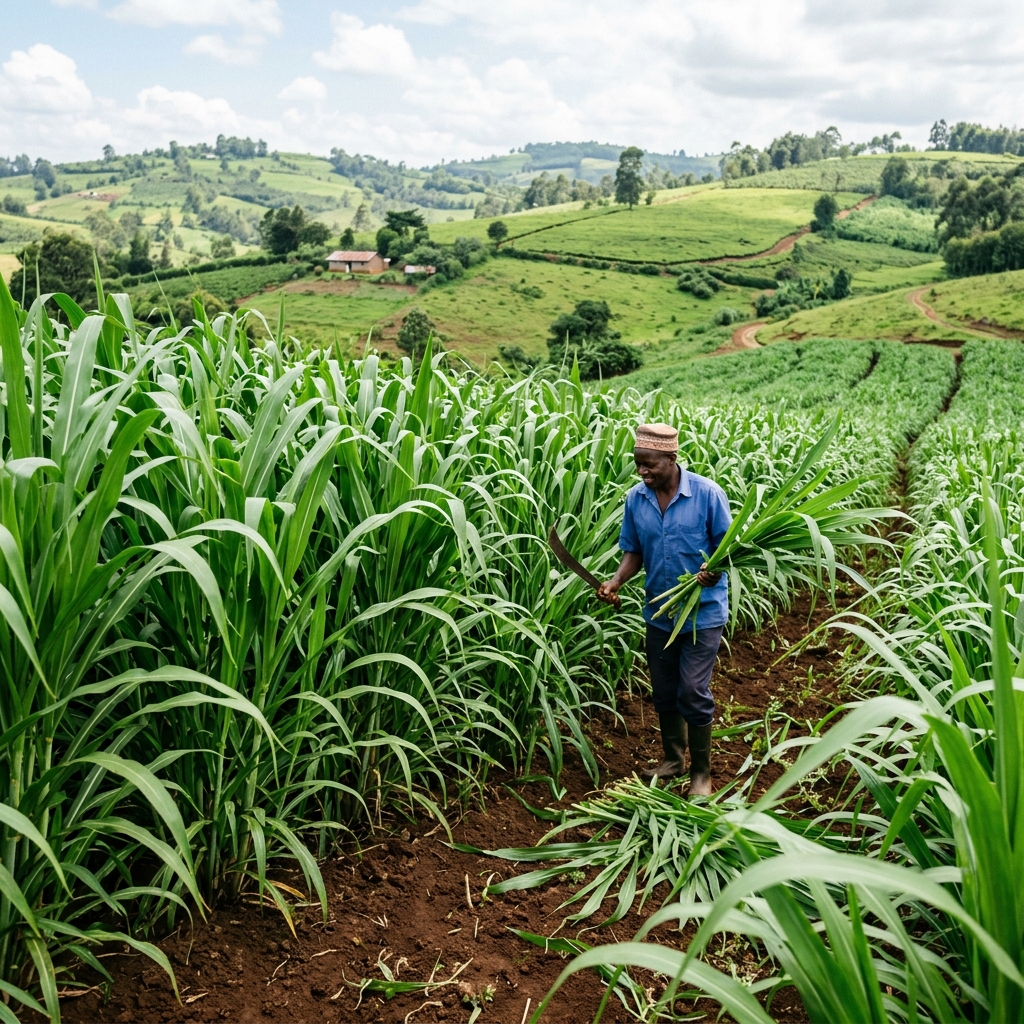
Why Nandi is a natural dairy county
Three structural conditions make Nandi County one of Kenya's highest-potential dairy zones outside the established Rift Valley dairy belt.
Nandi's red clay loam soils — derived from Tertiary volcanic rocks — hold moisture well enough to support Napier grass production through dry spells without irrigation. The same soils that make Nandi excellent for tea production also produce high-yield fodder crops. Unlike the sandy soils of Coast or the shallow rocky soils of parts of Baringo, Nandi soils give Napier roots the depth and moisture they need for rapid regrowth after every cut.
Nandi receives 1,400 to 1,800 mm per year with a relatively even distribution — two wet seasons with no severely dry months. This eliminates the irrigation infrastructure cost that makes dairy farming in drier counties expensive. Year-round green fodder from Napier reduces dependence on purchased dairy meal, cutting the single largest variable cost in dairy production.
Nandi County sits adjacent to Uasin Gishu and within 60 kilometres of Eldoret — Kenya's second-largest milk processing hub. New KCC, Brookside, and smaller processors all operate collection routes through Nandi, providing reliable offtake and reducing the post-harvest loss from milk that cannot reach a market quickly enough.
Nandi soil data for fodder crops
| Nutrient | Nandi average | Napier/silage optimum | Status | Action |
|---|---|---|---|---|
| Soil pH | 5.2 – 6.0 | 5.5 – 7.0 | Low – Adequate | Lime if below 5.5 |
| Total Nitrogen (g/kg) | 1.4 – 2.2 | > 1.5 g/kg | Adequate – Good | CAN after every Napier cut |
| Phosphorus (mg/kg) | 10 – 22 | > 15 mg/kg | Marginal – Adequate | DAP at Napier establishment |
| Potassium (mg/kg) | 160 – 320 | > 120 mg/kg | Adequate | Replaced by boma manure application |
| Organic Carbon (g/kg) | 16 – 28 | > 15 g/kg | Good | Maintain with manure application |
Source: ShambaIQ precision soil mapping, Nandi County average. Get your farm-specific Nandi reading here.
Napier grass — establishment and management in Nandi
Napier grass is a perennial crop that, once established, produces fodder for 10 to 15 years with annual replanting only when stand density drops. Getting establishment right is a decade-long investment.
Establishment (Month 1)
Plant splits or tissue-culture plantlets at 90 cm between rows and 50 cm within rows. Apply DAP at 50 kg per acre in the furrow. First harvest at 3 to 4 months after planting when plants reach 1.0 metre height. Establishment is the only time DAP is needed — all subsequent nutrition comes from CAN after each cut.
Production phase (Year 1 onwards)
Harvest every 6 to 8 weeks at 1.0 to 1.2 metre height. Apply CAN at 30 to 50 kg per acre immediately after each cut. 4 to 6 cuts per year is achievable in Nandi's rainfall conditions. Yield per cut ranges from 3 to 6 tonnes of fresh material per acre, giving 15 to 30 tonnes per acre per year.
Quality management
Cut at 1.0 to 1.2 metres — not taller. Over-mature Napier (above 1.5 m) has crude protein below 8 percent, compared to 12 to 15 percent in correctly-timed cuts. Feed immediately after cutting where possible — wilted Napier loses palatability within 24 hours in Nandi's humidity.
Pest management — Napier stunt disease
Napier stunt disease (phytoplasma) causes stunted, bushy growth with numerous small leaves and no productive fodder yield. It is spread by leafhopper insects and has no cure — infected stools must be removed and burned. The primary prevention is planting tissue-culture plantlets certified disease-free rather than splits from unknown-origin stands.
Silage maize — dry season feed security in Nandi
Napier grass provides green fodder year-round, but dry season quality declines as growth slows. Silage maize, made during the long rains and stored, provides high-energy, consistent-quality feed that maintains milk production through the driest months.
| Stage | Timing | Target | Why it matters |
|---|---|---|---|
| Harvest stage | 90 – 110 days | Dough stage — grain visible, plant 60–65% moisture | Higher moisture ferments poorly; lower moisture is difficult to compact |
| Chop length | At harvest | 2 – 3 cm pieces | Long chop leaves air pockets that cause spoilage |
| Compaction | During filling | Every 15 cm layer firmly compacted | Air exclusion is critical — oxygen causes aerobic spoilage |
| Cover | Immediately after filling | Heavy polythene sealed with soil or tyres | Delays of over 30 minutes after covering allow surface spoilage |
| Fermentation | 3 – 4 weeks sealed | pH should reach 3.8 – 4.2 | Lactic acid fermentation preserves nutrients for 6 to 12 months |
| Feeding rate | Daily during dry season | 5 – 8 kg per cow per day (as supplement) | Silage is a supplement — always feed alongside Napier or other roughage |
Boma manure — quantifying the fertilizer asset
Most Nandi dairy farmers treat boma manure as a waste disposal problem rather than an asset. Correctly composted and applied, boma manure from two dairy cows can supply 40 to 50 percent of the nitrogen, phosphorus, and potassium needed for 1 acre of Napier grass — significantly reducing the CAN and DAP bill.
| Manure source | N (%) | P2o5 (%) | K2o (%) | Equivalent fertilizer per tonne |
|---|---|---|---|---|
| Fresh cattle dung | 0.5 | 0.25 | 0.5 | 5 kg CAN + 2.5 kg DAP + 5 kg MOP |
| Composted cattle manure | 1.5 | 1.0 | 1.5 | 15 kg CAN + 10 kg DAP + 15 kg MOP |
| Fresh chicken manure | 1.6 | 1.5 | 0.9 | 16 kg CAN + 15 kg DAP + 9 kg MOP |
| Composted chicken manure | 3.0 | 2.5 | 1.8 | 30 kg CAN + 25 kg DAP + 18 kg MOP |
Step-by-step: Napier establishment and silage making in Nandi
- 1
Test Nandi soil phosphorus before Napier establishment
Use ShambaIQ at shambaiq.com/app to confirm your soil's phosphorus status. Nandi's red clay loam soils commonly show phosphorus of 10 to 22 mg/kg — marginal to adequate. DAP at establishment is essential regardless of existing phosphorus levels because Napier requires high phosphorus at root establishment to develop the extensive root system that supports 10 to 15 years of productive life.
- 2
Prepare land and plant Napier splits or plantlets
Plough to 25 cm depth and form furrows 90 cm apart. Plant Napier splits (stem cuttings with 2 to 3 nodes) or tissue-culture plantlets at 50 cm within the furrow. Apply DAP at 50 kg per acre in the furrow before planting, covered with soil before placing the splits. Tissue-culture plantlets from certified nurseries have higher yield potential and are free from stunt disease — worth the higher initial cost for a long-term fodder stand.
- 3
Apply CAN after every harvest
Apply CAN at 30 to 50 kg per acre immediately after each harvest, when stumps are 5 to 10 cm high. Napier's rapid regrowth has a very high nitrogen demand — yield per cut drops progressively without post-harvest nitrogen replacement. On Nandi soils, 4 to 6 cuts per year at 50 kg CAN per cut equates to 200 to 300 kg CAN per acre per year — a significant input cost that must be factored into dairy enterprise profitability.
- 4
Harvest Napier at correct height for quality
Harvest Napier at 1.0 to 1.2 metres height, approximately every 6 to 8 weeks. Harvesting too young reduces total dry matter yield. Harvesting too old — above 1.5 metres — significantly reduces crude protein content from 12 to 15 percent to below 8 percent as stems lignify. Cattle will eat over-mature Napier but its nutritional contribution to milk production drops sharply.
- 5
Plant silage maize for dry season reserves
Plant silage maize at the start of the long rains at 75 x 25 cm spacing with DAP at 1 bag per acre and CAN top-dressing at knee height. Harvest at the dough stage (90 to 110 days) when whole-plant moisture is 60 to 65 percent. Chop to 2 to 3 cm and ensile immediately. Silage maize on Nandi soils consistently produces 15 to 20 tonnes of dry matter per acre — the highest dry matter yield of any single-harvest fodder crop.
- 6
Manage boma manure for soil fertility return
Collect manure from the zero-grazing unit daily. Compost in a covered pit for 6 to 8 weeks before application to Napier or cropland. Well-composted boma manure applied at 5 to 10 tonnes per acre per year progressively builds soil organic matter, reduces purchased fertilizer requirements, and returns the nutrients removed by high-yield Napier and silage maize back to the soil.
Dairy enterprise budget per cow — Nandi county 2026
| Item | Monthly cost (KES) | Annual cost (KES) |
|---|---|---|
| Dairy meal/concentrates (2 kg/day) | 3,600 | 43,200 |
| Napier grass fertilizer (CAN for 0.25 acre) | 1,500 | 18,000 |
| Veterinary costs (AI, vaccines, deworming) | 1,200 | 14,400 |
| Labour — zero-grazing unit | 1,000 | 12,000 |
| Silage maize input (amortised) | 800 | 9,600 |
| TOTAL ANNUAL COST | KES 8,100 | KES 97,200 |
| Revenue (18 L/day x KES 45/L x 365 days) | KES 24,300 | KES 295,650 |
| Net margin Per Cow | KES 16,200 | KES 198,450 |
Milk price assumes New KCC or Brookside collection at farm gate. Find Nandi County agrovets and current dairy input prices here.
Free Precision Tool
Optimize Fodder Yields: Plan your silage maize inputs at ShambaIQ Nandi Silage Tool.
ShambaIQ calculates your Nandi soil's phosphorus status for Napier establishment and gives you the complete fertilizer programme for your fodder system. Free. No sign-up required.
Open Nandi Silage Tool